
Salesforce Experience Cloud implementations depend on three closely connected areas: administration, setup, and configuration. Each has a different purpose. Administration covers the management of an Experience and its external users. Setup establishes the Experience and prepares it for use. Configuration applies the features and capabilities required by the business process.
For the Salesforce Certified Experience Cloud Consultant exam, Administration, Setup, and Configuration is a 25% domain. Salesforce’s current exam guide lists seven objectives in this area: implementing Channel Sales Partner Relationship Management (PRM), describing Experience deployments and migrations, enabling and activating an Experience, recommending and implementing Delegated External User administration, building a public Experience, configuring and setting up Topics, and applying ticketing and Agentforce Service capabilities for Experience Cloud.
The best way to approach this domain is to understand the differences between these capabilities. A scenario about managing external users is not the same as a scenario about activating a site. Likewise, choosing a deployment method is a different decision from configuring an Experience feature.
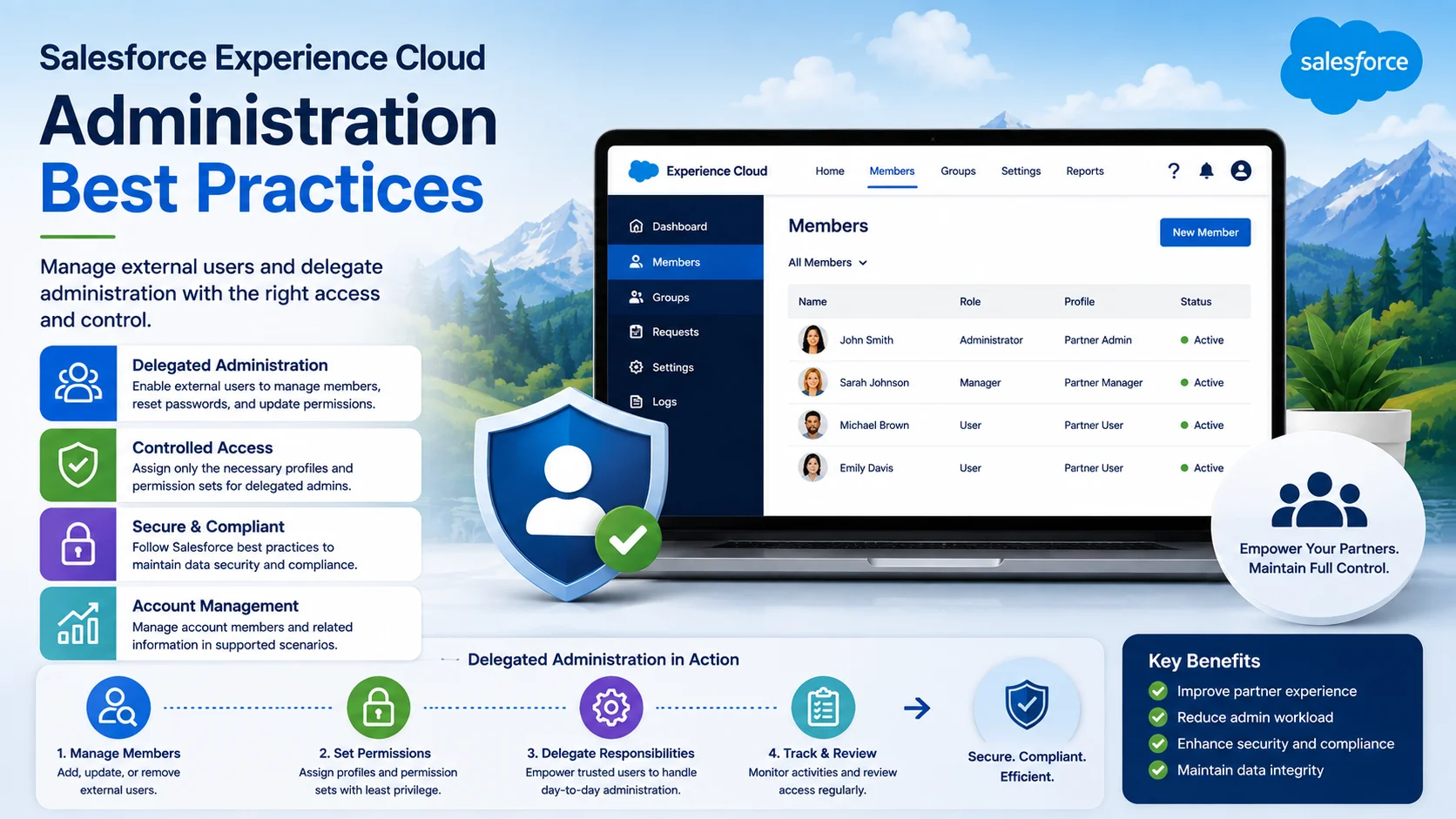
Salesforce Experience Cloud Administration Best Practices
Administration focuses on the people responsible for managing the Experience and its external users. One of the clearest examples is Delegated External User administration.
Salesforce allows eligible external users to be designated as delegated site administrators. Depending on the configuration, delegated administrators can add, update, and disable members, reset passwords, and manage user permissions. The administrator can also specify which external profiles and permission sets the delegated administrator is allowed to manage. Salesforce lists specific permissions and license requirements for this capability.
This creates an important distinction between delegated administration and full Salesforce administration. A delegated administrator is given a defined set of external-user responsibilities. Salesforce’s documentation requires the appropriate permissions and explains how the profiles and permission sets that the delegated administrator can manage are selected.
| Administration Requirement | What Salesforce Provides |
| Manage external users | Manage External Users permission |
| Delegate site administration | Delegated External User Administrator |
| Control managed profiles | Delegated External User profiles |
| Control managed permission sets | Delegated External User Permission Sets |
| Manage external members | Supported delegated-user administration functions |
Salesforce also documents practical prerequisites for delegated administration. For example, the delegated administrator needs the required account and contact access, and the relevant profiles and permission sets must be configured for assignment.
Common Administration Mistake
A frequent exam trap is choosing a broad administrative permission when the requirement specifically asks for external-user administration. Salesforce distinguishes Manage External Users from broader administrative permissions, so the wording of the scenario matters.
Another current Salesforce Help article notes that users managing Experience Cloud site users may need profiles to be included in a Delegated Administration group’s Assignable Profiles before those profiles appear as options during user creation.
The practical lesson is simple: match the administrative permission to the actual task described in the scenario.
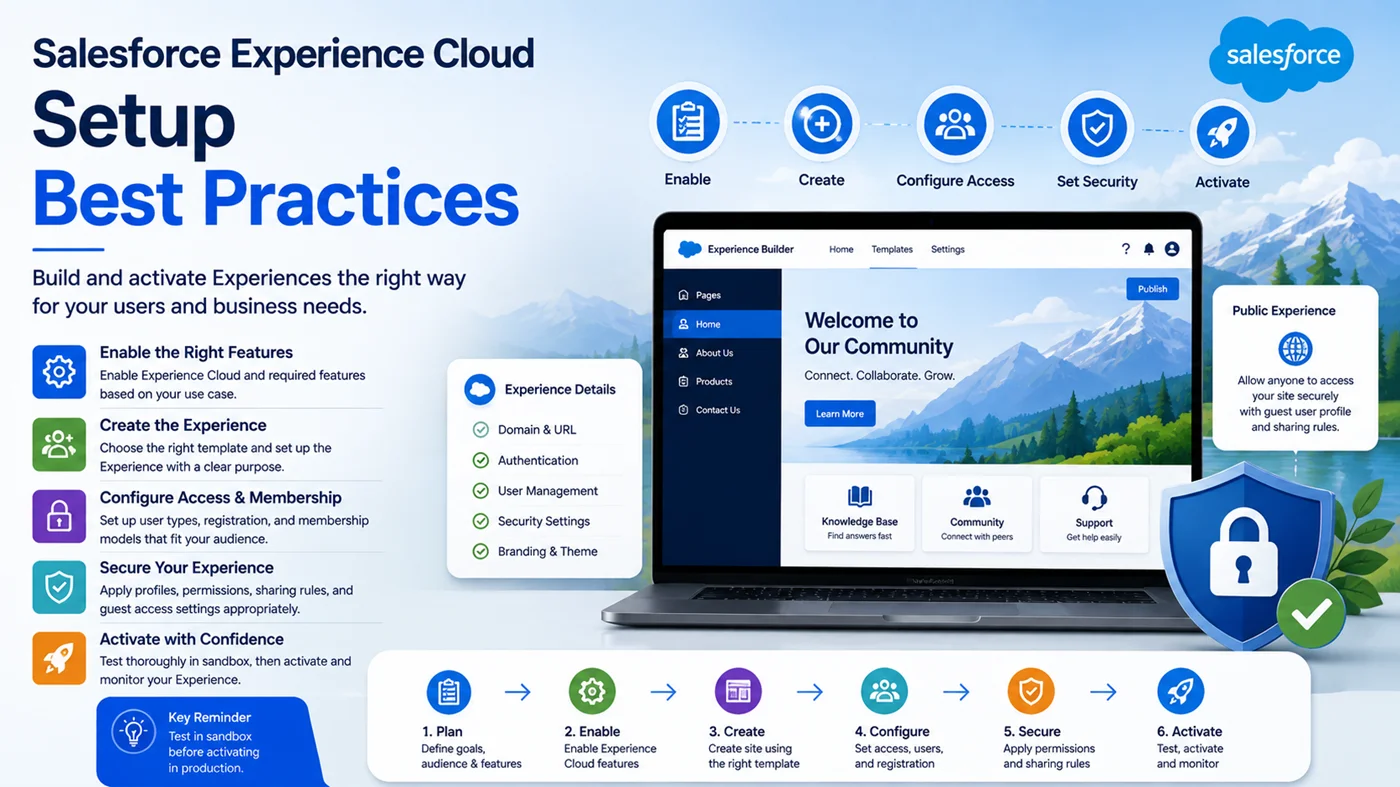
Salesforce Experience Cloud Setup Best Practices
Setup establishes the Experience and prepares it for the intended users. Salesforce specifically includes enabling and activating an Experience and building a public Experience in the current certification objectives.
A useful way to separate the setup stages is to distinguish between publishing and activation. Salesforce documentation for Experience Cloud describes publishing as making site customizations available, while activation makes the site available to its intended users. A Salesforce Help example for a service site explicitly states that publishing does not activate the site and that activation is a separate step.
This distinction can matter in exam questions. A scenario may tell you that the pages have already been published but ask what must happen before customers or partners can access the site. The answer may involve activation rather than another page edit.
Building a Public Experience
Public access is another explicit exam objective. Salesforce provides a guest user profile for public Experiences and uses that profile to control access to data, content, and objects available without authentication.
Public access should therefore be treated as an access configuration, not simply a design choice. Salesforce’s guest-user documentation requires administrators to review object and field permissions and configure appropriate sharing for the objects that public users need to access.
Salesforce also provides a Guest User Sharing Rule Access Report that helps administrators identify the objects, records, and fields accessible to guest users through guest-user sharing rules.
For a Salesforce Certified Experience Cloud Consultant Practice Test, a useful distinction is whether the scenario describes an authenticated external user or an unauthenticated guest. That difference can change the correct setup and security approach.
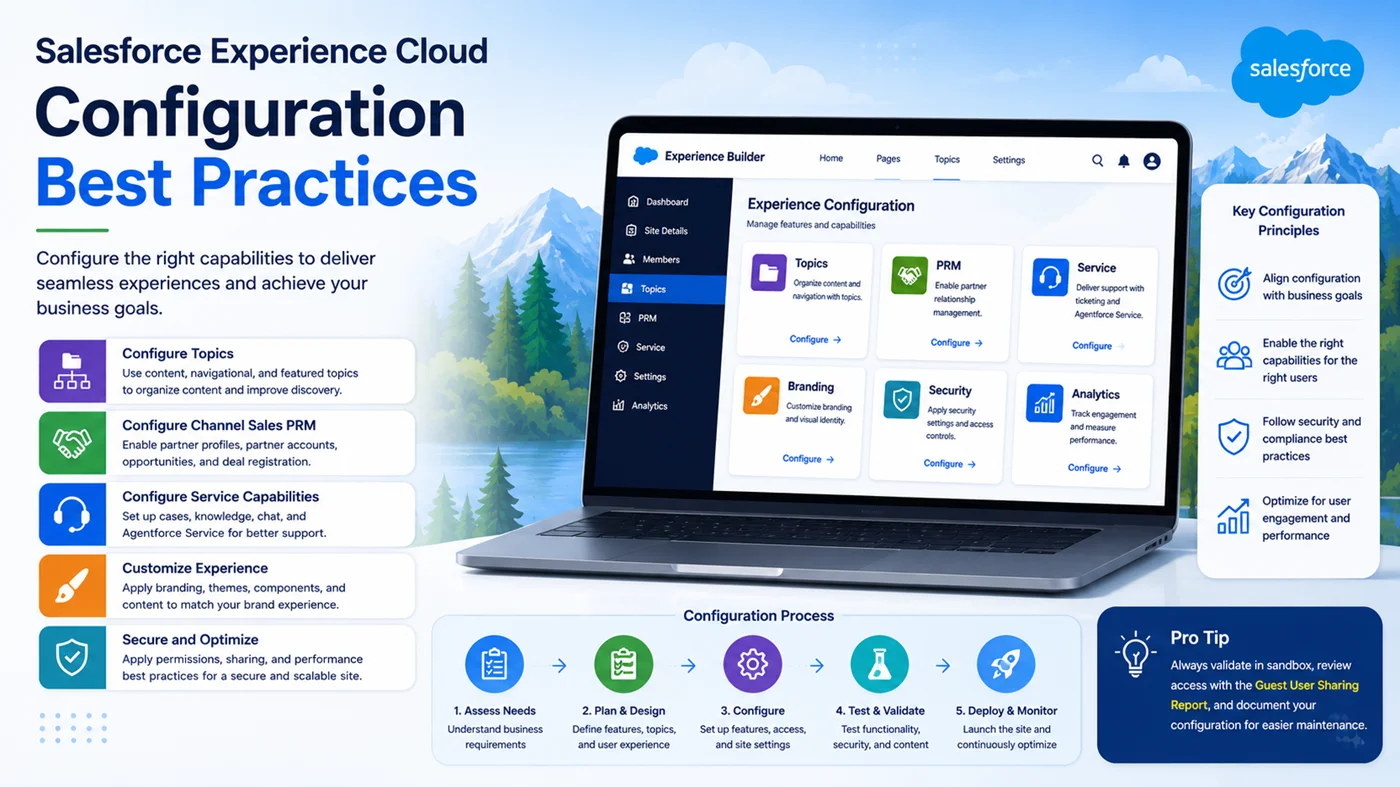
Salesforce Experience Cloud Configuration Best Practices
Configuration applies the features required after the Experience has been established.
Salesforce’s current exam guide specifically includes Channel Sales PRM, Topics, and ticketing and Agentforce Service capabilities.
Configuration also depends on the Experience technology. Salesforce’s Experience Cloud documentation distinguishes among LWR, Aura, and Visualforce sites, and the available settings and capabilities are not identical across all implementations. This means an answer that is valid for one Experience architecture should not automatically be assumed to apply to another.
Configure Topics
Topics are an explicit objective in the current exam guide. Salesforce documents several Topic types, including content topics, navigational topics, and featured topics, with different purposes and configuration requirements.
For example, Salesforce states that content topics can be created from Content Management | Topics, while navigational topics are configured through the Topics settings and can be associated with Salesforce Knowledge content when the required data categories are enabled.
That distinction is useful in scenario questions. If the requirement is to organize content around common themes, content topics may be relevant. If the requirement is to structure site navigation around topics and surface related Knowledge articles, navigational topics involve a different configuration path.
Configure Channel Sales PRM
Channel Sales Partner Relationship Management is another explicit objective. Salesforce’s exam guide requires candidates to know how to implement Channel Sales PRM.
The main decision point is the business model. A customer-facing Experience and a partner-sales Experience can have very different requirements. PRM should therefore be considered when the scenario involves channel partners and partner-sales processes, rather than simply because the site has external users.
Configure Ticketing and Agentforce Service Capabilities
Salesforce also includes ticketing and Agentforce Service capabilities in this domain. Agentforce Service supports customer service processes, and Salesforce provides specific guidance for adding an Agentforce Service agent to an Experience Cloud site. The current documentation describes deploying the agent to a selected Experience Cloud site and then connecting it through a flow.
Salesforce also documents Service features for Experience Cloud, including Salesforce Knowledge and Site Case Feed. Some service capabilities have prerequisites or licensing requirements, and Site Case Feed requires Chatter to be enabled. Salesforce notes that beginning with Summer ’26, Chatter is turned off by default in new orgs.
This is an example of why configuration questions should be read for prerequisites. The correct solution may depend on whether the necessary service feature, license, or org setting is already available.
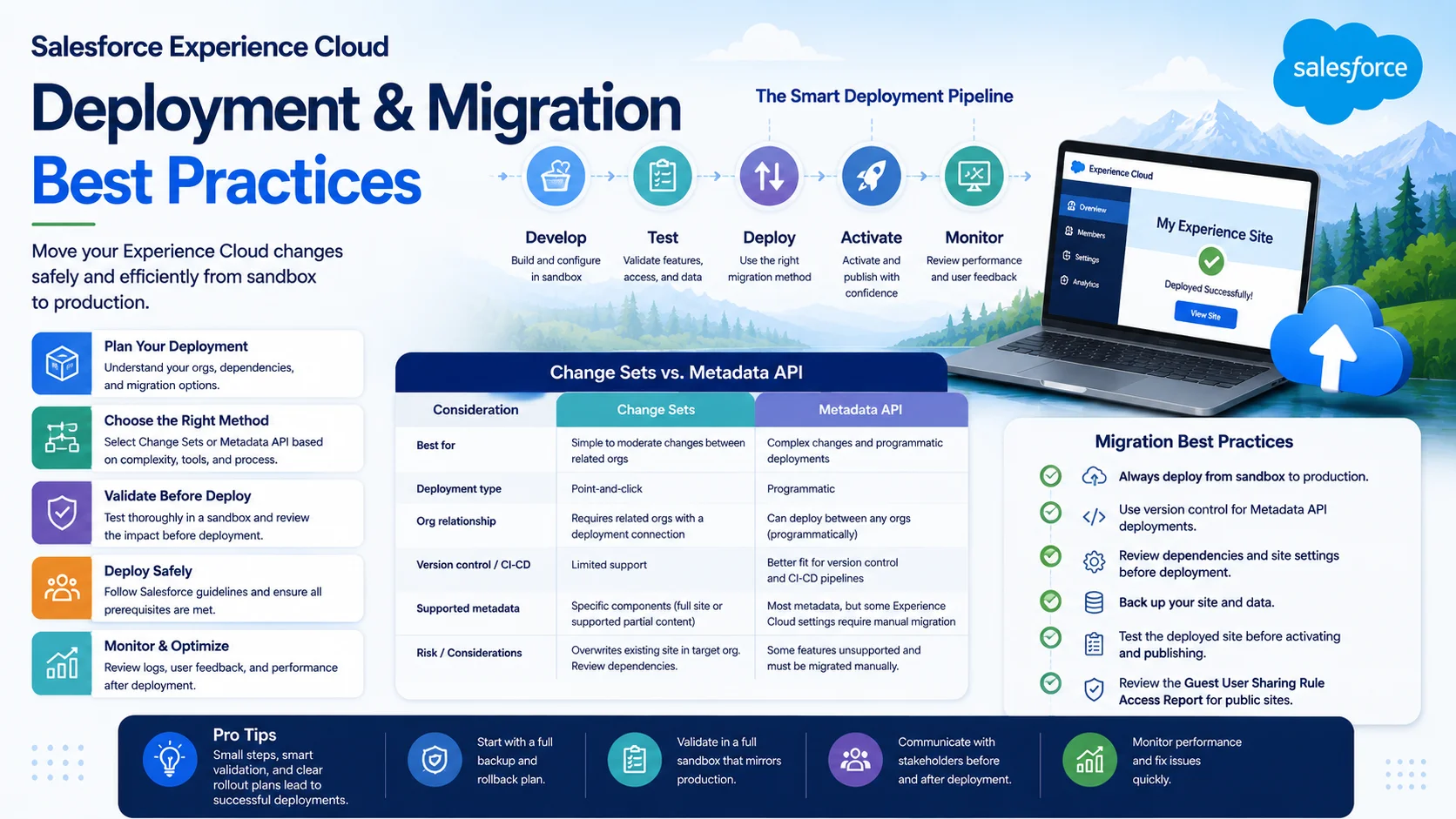
Salesforce Experience Cloud Deployment and Migration Best Practices
Experience deployments and migrations are easy to overlook because they sit between configuration and release management, but Salesforce explicitly includes them in the 25% exam domain.
Salesforce recommends creating, customizing, and testing an Experience Cloud site in a test environment such as a sandbox before deploying it to production. Salesforce documents change sets and Metadata API as migration approaches. The choice depends on factors including the complexity of the changes, familiarity with developer tools, and the organization’s application lifecycle management model.
The important differences are more specific than simply “point and click versus programmatic.”
| Deployment Consideration | Change Sets | Metadata API |
| Org relationship | Requires related orgs with a deployment connection | Programmatic deployment between orgs |
| Working model | Declarative, point-and-click | Programmatic |
| Complex changes | Less suited to complex release processes | Salesforce identifies it as suitable for complex changes |
| ALM and audit | Can fit declarative org workflows | Better fit for more rigorous change-management and audit processes |
| Version control | Not required | Can fit workflows using version control |
| Experience limitations | Supported Experience components have specific deployment rules | Some Experience Cloud settings and features are not supported and require manual migration |
Salesforce explicitly states that Metadata API is appropriate when changes are complex or when a more rigorous change-management, audit, or version-control process is required. Salesforce also warns that some Experience Cloud site settings and features are not supported by Metadata API and must be migrated manually.
Change Sets are designed for related orgs with a deployment connection. Salesforce documents the Network component type for moving a full Experience Cloud site and the Digital Experience component type for partial site content in enhanced LWR sites.
There is also a significant deployment risk to remember. Salesforce states that deploying an inbound change set overwrites the Experience Cloud site in the target org. Salesforce additionally instructs administrators to consider dependencies, manually reconfigure unsupported items, add required site data, and test the deployed site before publishing it.
This is more than a technical detail. It affects how a release should be prepared. A change set should be validated as a complete deployment rather than treated as a small patch to an otherwise untouched target site.
Salesforce Experience Cloud Exam Traps to Know
The most useful exam preparation comes from recognizing distinctions that Salesforce documents clearly.
- Delegated Administration vs. Full Administration
Delegated External User administration is a controlled external-user administration model. It is not equivalent to unrestricted Salesforce administrator access. Salesforce documents the permissions, licenses, profiles, and permission sets involved.
- Publish vs. Activate
Publishing site changes and activating the site are separate actions. A published Experience is not automatically equivalent to an activated Experience.
- Public Experience vs. Guest Data Access
Making an Experience public does not mean that all Salesforce data becomes public. Salesforce uses the guest user profile, permissions, and sharing mechanisms to control what unauthenticated users can access.
- Topics Are Not All the Same
Content topics, navigational topics, and featured topics serve different purposes and have different configuration procedures.
- Change Sets vs. Metadata API
The better deployment method depends on the org relationship, complexity, ALM approach, and tooling. Salesforce specifically recommends considering these factors rather than treating one method as universally superior.
Salesforce Experience Cloud Best Practices: A Focused Review
Before moving an Experience toward production, review the three areas independently and then check how they interact.
| Area | Questions to Verify |
| Administration | Are the correct users receiving the appropriate external-user administration responsibilities? |
| Setup | Is the Experience enabled, configured for its intended audience, and activated at the appropriate point? |
| Configuration | Are the selected features supported by the site’s architecture and correctly configured? |
| Deployment | Does the migration method fit the org relationship, complexity, ALM model, and supported metadata? |
This framework is more useful than memorizing a single sequence because the official exam objectives cover different implementation scenarios. The current Salesforce exam guide is the authority for the scope of the domain, while Salesforce Help provides the detailed behavior, prerequisites, deployment rules, and configuration procedures behind those objectives.
When reviewing Salesforce Certified Experience Cloud Consultant Exam Questions, pay particular attention to words that change the technical answer: delegated, public, activate, Topic type, partner, migration, change set, Metadata API, and prerequisite. Those terms can indicate which Salesforce capability the scenario is actually testing.
The most reliable preparation method is to study the official objective, verify the corresponding Salesforce Help documentation, and then practice applying the documented behavior to realistic scenarios. That keeps Administration, Setup, and Configuration focused on the actual Salesforce implementation rather than on memorized terminology.