
Sales Cloud is back.
Salesforce’s September 2026 Sales Cloud product release page once again uses the familiar name and explicitly states that Sales Cloud was formerly known as Agentforce Sales.
That may sound like a simple product rename, but it points to a more interesting shift taking place across Salesforce.
At Dreamforce 2025, Salesforce pushed the Agentforce name much deeper into its product portfolio. Sales became Agentforce Sales. Service became Agentforce Service. Marketing, Commerce, Field Service, and Revenue Management were also presented as Agentforce-branded applications as part of Salesforce’s broader Agentic Enterprise strategy.
Less than a year later, some of those familiar Salesforce brands are returning to the foreground.
This does not mean Salesforce is abandoning Agentforce. Agentforce remains one of the company’s most important technologies and growth priorities.
Instead, Salesforce appears to be reconsidering where the Agentforce name belongs within its product architecture.
That distinction is important because Salesforce has not publicly given a complete explanation for these naming changes. The changes themselves can be verified. The reasons behind them require analysis.
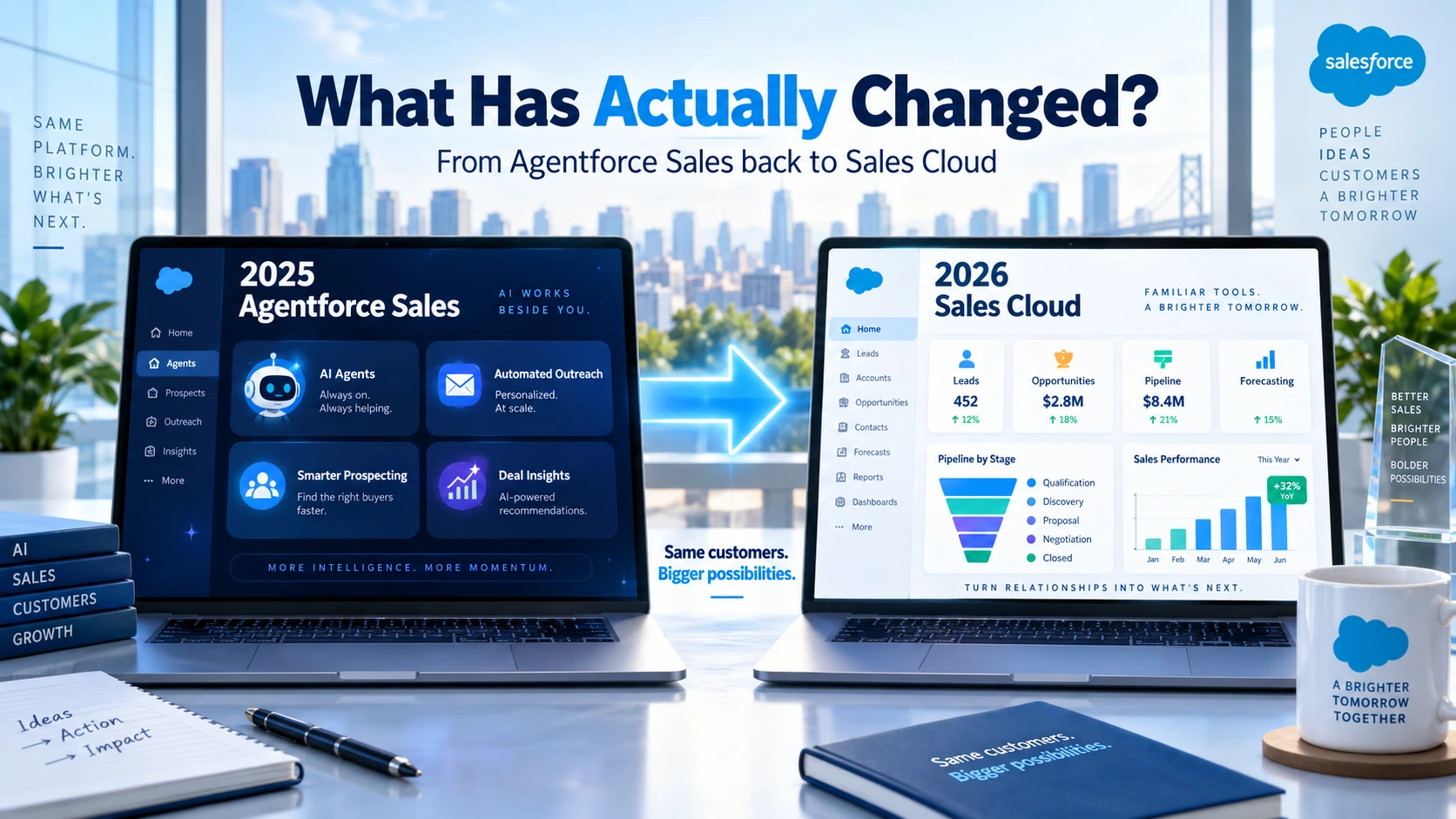
What Has Actually Changed?
Sales Cloud gives us the clearest example.
The sequence is now straightforward:
Sales Cloud → Agentforce Sales → Sales Cloud
Salesforce’s October 2025 Agentic Enterprise announcement officially referred to Agentforce Sales as one of several Customer 360 applications with conversational agents embedded directly into business workflows.
Salesforce’s current September 2026 release page, however, has gone back to Sales Cloud.
Service shows a similar but less complete change. Salesforce’s main customer-service pages now prominently use Service Cloud and describe Agentforce as the AI technology bringing agents, employees, and trusted data together.
Commerce shows why this is not a simple company-wide rollback. Its current page is still headed Agentforce Commerce (formerly Commerce Cloud), even though Commerce Cloud continues to appear heavily throughout the page.
The result is a portfolio currently using a mixture of old and new terminology.
| Product area | Agentforce-era branding | Current public position |
| Sales | Agentforce Sales | Sales Cloud has clearly returned |
| Service | Agentforce Service | Main public pages prominently use Service Cloud |
| Commerce | Agentforce Commerce | Agentforce Commerce remains the headline name |
| Sales documentation | Agentforce Sales | Salesforce Help still says Sales Cloud is now Agentforce Sales |
| Platform architecture | Headless 360 | Headless 360 technology remains active |
In fact, Salesforce Help still says “Sales Cloud is now Agentforce Sales”, even while the newer product release page says Sales Cloud was formerly Agentforce Sales.
That inconsistency is useful evidence in itself. Salesforce appears to be in the middle of a naming transition rather than executing one clean portfolio-wide reversal.
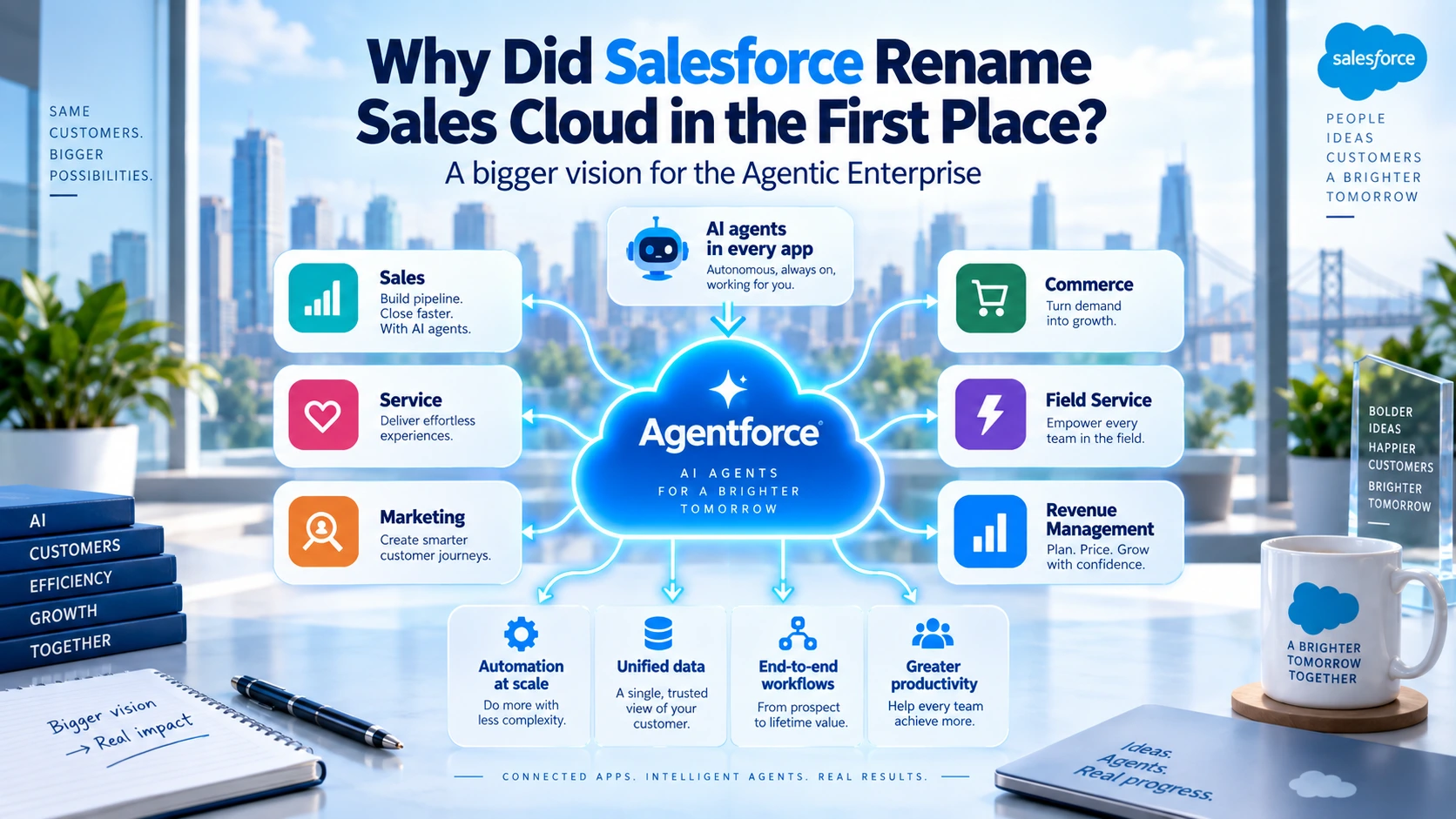
Why Did Salesforce Rename Sales Cloud in the First Place?
The original Agentforce rebrand made sense within Salesforce’s strategy at the time.
At Dreamforce 2025, Salesforce was pushing the idea of the Agentic Enterprise, where AI agents would not sit beside CRM as optional assistants. Instead, they would work directly inside sales, service, marketing, commerce, field service, revenue, and other business processes.
Salesforce’s announcement described:
- Agentforce Sales automating prospecting, qualification, and quoting.
- Agentforce Service powering proactive customer support.
- Agentforce Marketing building campaigns and journeys.
- Agentforce Commerce providing conversational shopping.
- Agentforce Field Service assisting scheduling and field work.
- Agentforce Revenue Management supporting quoting, billing, and revenue operations.
Putting Agentforce directly into product names reinforced a clear message: AI agents were becoming fundamental to Salesforce applications.
Salesforce continued using those names well into 2026. As recently as September 3, it announced new Core, Advanced, and Max editions for Agentforce Sales, Agentforce Service, and Agentforce Industries.
That makes the return of Sales Cloud branding particularly notable.
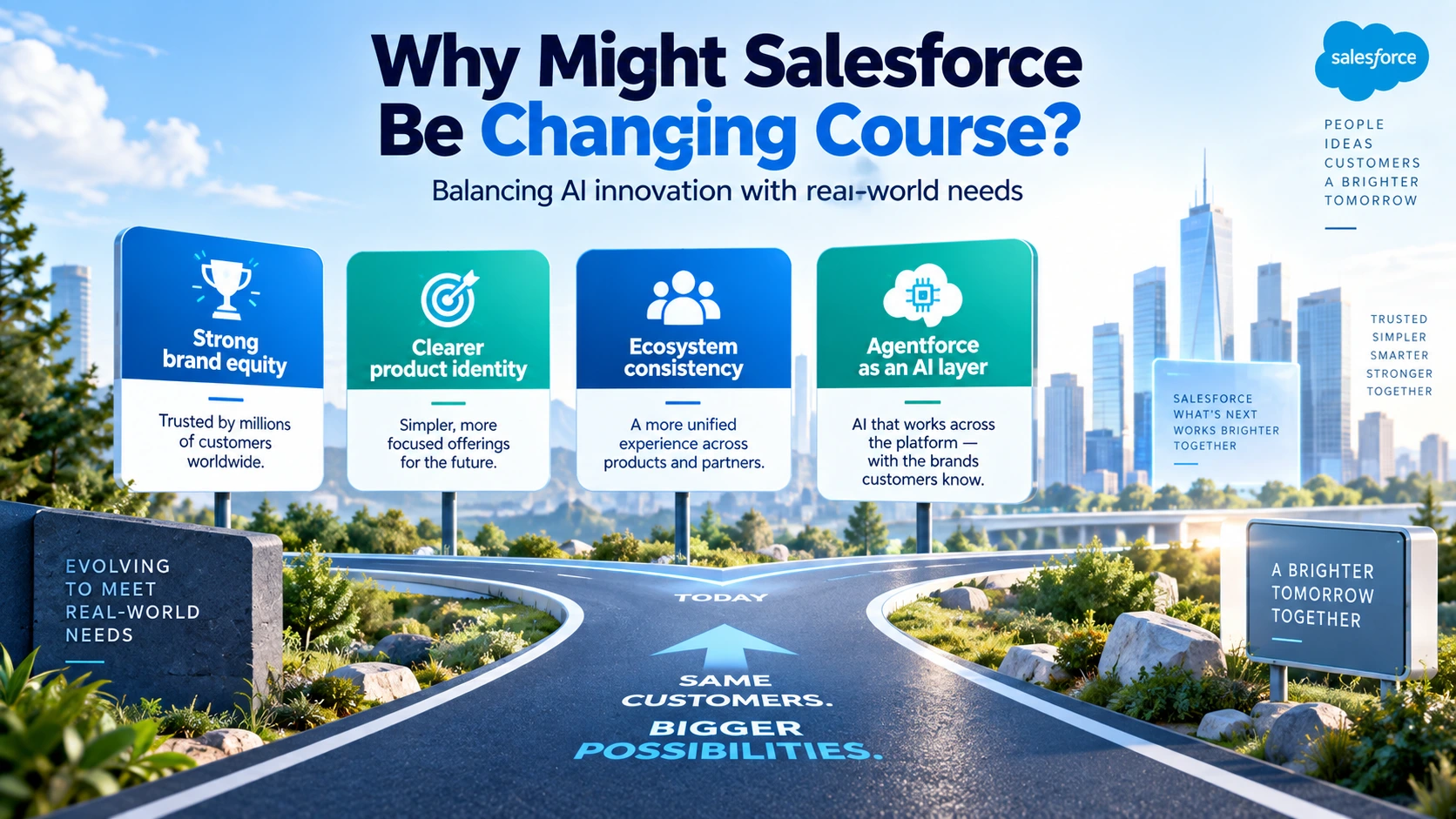
Why Might Salesforce Be Changing Course?
This is where confirmed facts end and analysis begins.
Salesforce has not publicly provided a definitive explanation for restoring the Sales Cloud name. But several practical factors could explain why the company is softening parts of its Agentforce rebrand.
1. Sales Cloud and Service Cloud Have Strong Brand Equity
Sales Cloud and Service Cloud have been part of the Salesforce ecosystem for years.
Customers know the names. Consultants specialize in them. Partners organize practices around them. Recruiters use them in job descriptions. Administrators search for them in documentation and Trailhead.
SalesforceKing own Sales Cloud lead-to-close guide is a good example of how deeply the name remains embedded in Salesforce learning and certification content.
Replacing a familiar product name creates an unnecessary translation step:
“Agentforce Sales? Oh, that’s what used to be Sales Cloud.”
Restoring Sales Cloud immediately removes that friction.
2. Too Much Agentforce Branding Can Blur Product Roles
There is another potential problem.
What exactly does Agentforce Sales mean to someone unfamiliar with Salesforce’s naming history?
Is it:
- Sales Cloud with Agentforce?
- a standalone AI sales product?
- a collection of sales agents?
- a Salesforce edition?
- or the replacement for Sales Cloud?
The underlying technology can be powerful while the branding remains difficult to explain.
A simpler structure is easier:
- Sales Cloud is the sales application.
- Service Cloud is the service application.
- Commerce Cloud is the commerce platform.
- Agentforce provides AI agents and agentic capabilities across Salesforce.
That hierarchy may be easier for customers, partners, and new buyers to understand.
3. Salesforce Has a Huge Ecosystem to Keep Consistent
Salesforce is not renaming a small standalone application.
Its product names appear across Help documentation, Trailhead modules, certifications, partner training, contracts, APIs, customer implementations, job descriptions, community content, and thousands of third-party resources.
The current Sales Cloud situation demonstrates the difficulty perfectly.
Salesforce’s latest product page says Sales Cloud was formerly Agentforce Sales, while Salesforce Help still says Sales Cloud is now Agentforce Sales.
Trailhead content also continues teaching Agentforce Sales terminology.
Maintaining recognizable application names while evolving the AI technology underneath them may simply create less disruption.
4. Agentforce May Work Better as a Horizontal AI Layer
This is potentially the most important strategic explanation.
Salesforce does not need to rename Sales Cloud to prove that Agentforce is transforming sales.
The current Sales Cloud release page already describes agents working throughout the revenue cycle. Service Cloud combines human representatives and AI agents. Commerce uses Agentforce for guided shopping, merchandising, and other experiences.
In other words:
Agentforce can transform every Salesforce product without becoming the name of every Salesforce product.
A cleaner structure could look something like this:
- Business applications: Sales Cloud, Service Cloud, Commerce Cloud, and other Salesforce products
- AI and agents: Agentforce
- Data: Data 360
- Platform: Salesforce Platform and its underlying platform capabilities
- Collaboration: Slack
That would preserve some of Salesforce’s strongest product brands while allowing Agentforce to become more important technically.
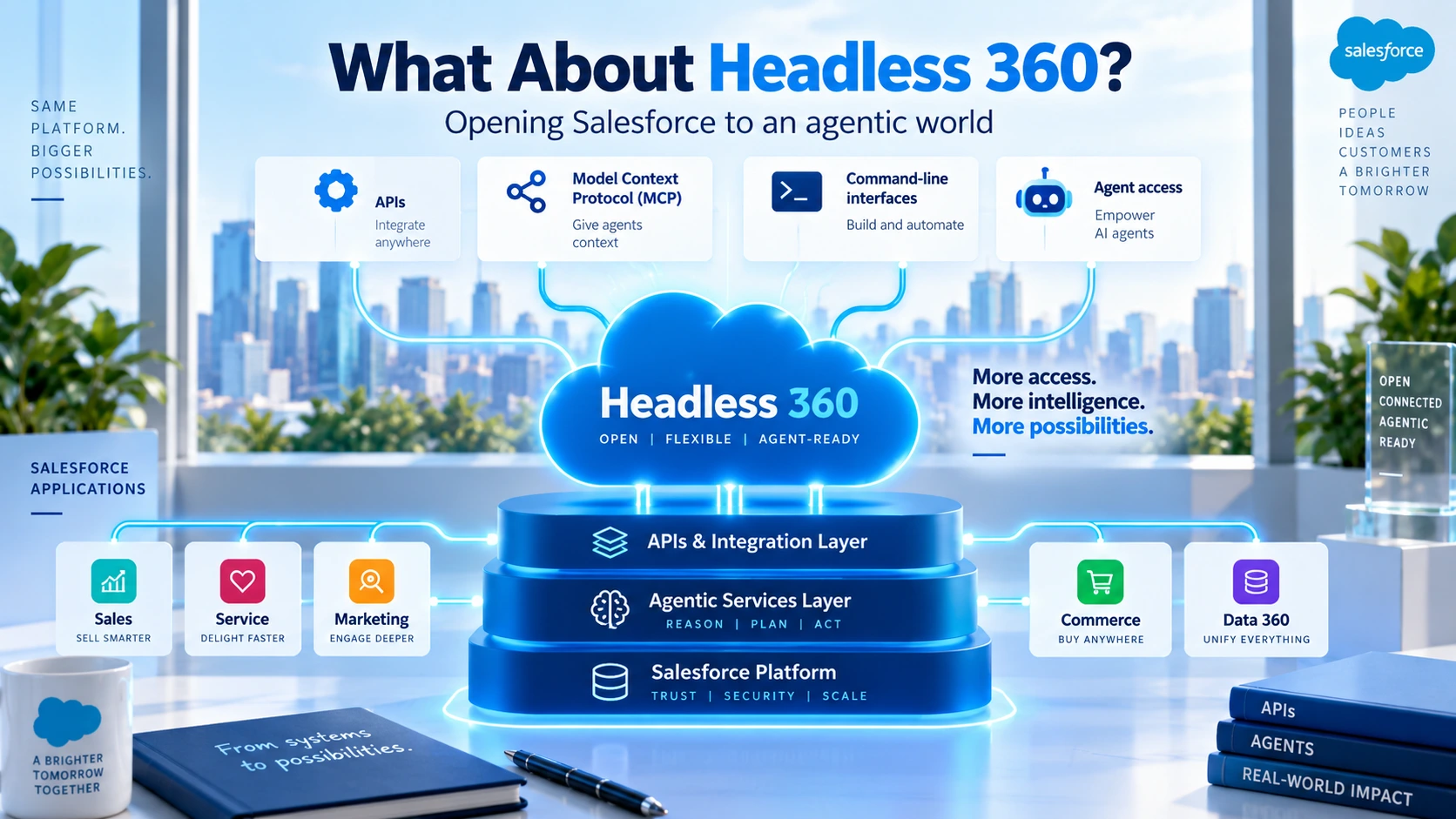
What About Headless 360?
Headless 360 adds another dimension to the story.
Salesforce introduced Headless 360 in April 2026 as part of an effort to make Salesforce capabilities accessible to AI agents through APIs, Model Context Protocol tools, command-line interfaces, and other nontraditional interfaces.
The technology is still active.
Salesforce’s developer documentation currently lists a Headless 360 MCP Server in beta, describing it as a way for MCP-aware agents to access Salesforce capabilities through a single connection.
So even if Salesforce adjusts the branding around its broader platform, that should not be confused with the disappearance of its headless or agent-oriented architecture.
The branding and the technology are two different questions.
Agentforce Is Definitely Not Going Away
Any suggestion that Salesforce is abandoning Agentforce would conflict with the company’s current investments.
In its Q2 FY27 results, Salesforce reported that Agentforce ARR exceeded $1.5 billion, up more than 240% year over year, while combined Agentforce and Data 360 ARR reached nearly $3.9 billion.
Salesforce also reported billions of Agentic Work Units delivered across Agentforce and Slack.
There is an important qualification: Salesforce says its Q2 FY27 Agentforce ARR measurement includes its AI offerings, Slackbot, and Headless 360. That context matters when interpreting the number.
More importantly, on September 14 Salesforce announced a new portfolio of job-ready Agentforce agents for sales, service, commerce, workforce, and other business functions. The new capabilities are designed to let agents handle more complex work, pursue longer-running goals, learn skills, and collaborate with other agents.
This is not what an Agentforce retreat looks like.
The more convincing interpretation is a branding adjustment around an AI strategy that continues to expand.
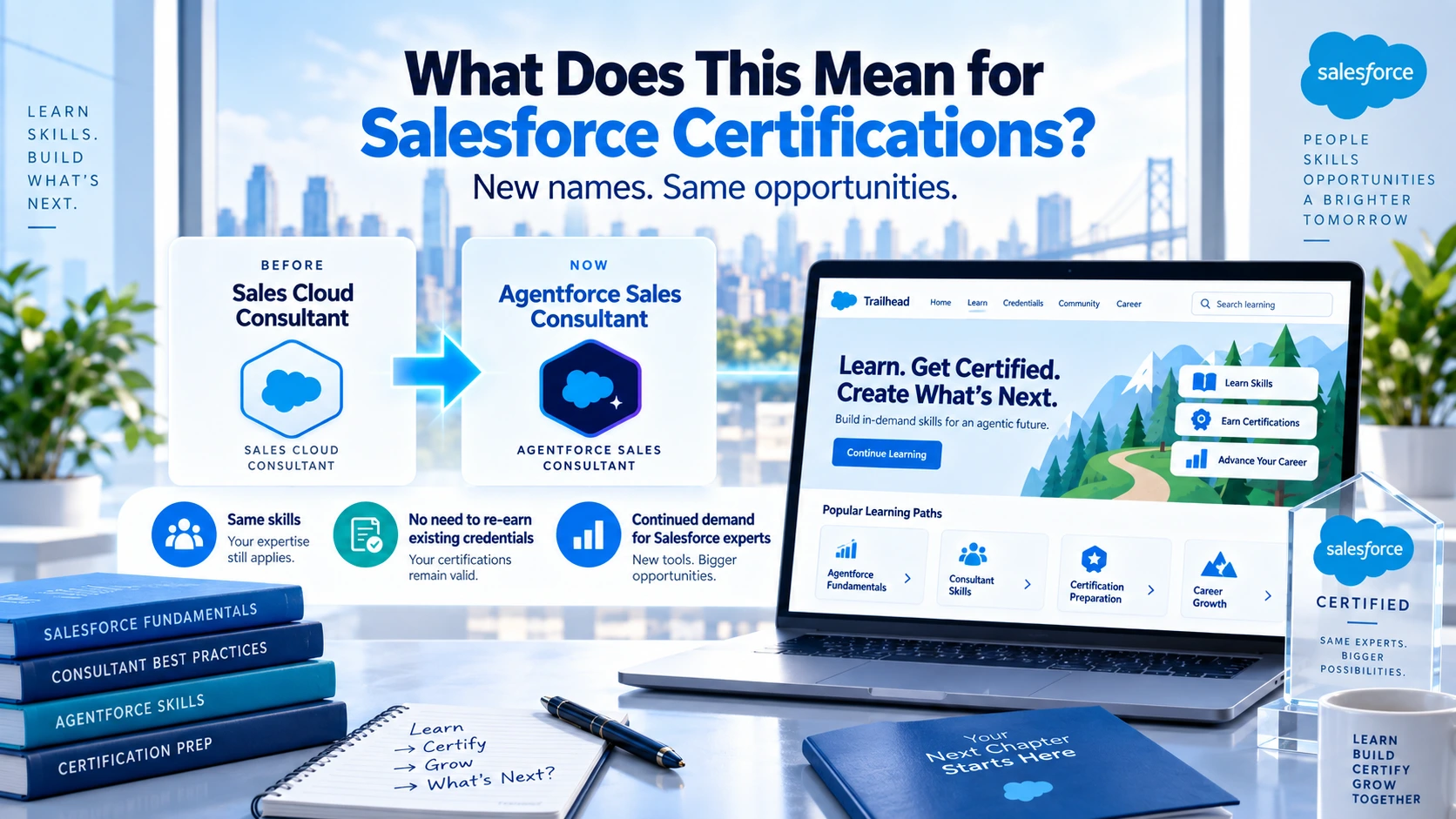
What Does This Mean for Salesforce Certifications?
The naming changes create an unusual situation for certification candidates.
Salesforce changed the names of 16 credentials on July 24, 2026, saying the updates were intended to align certification naming with its current products.
Among the changes:
- Sales Cloud Consultant became Agentforce Sales Consultant.
- Service Cloud Consultant became Agentforce Service Consultant.
- Field Service Consultant became Agentforce Field Service and Operations Consultant.
Salesforce said credential holders did not need to re-earn their certifications because of the name changes.
SalesforceKing covered the wider changes in our Salesforce certification overhaul for 2026.
Now the situation is particularly interesting: Sales Cloud has returned to Salesforce’s current product-release branding while the certification remains Agentforce Sales Consultant.
Could that credential be renamed again?
Possibly, but Salesforce has made no official announcement saying that will happen. Candidates should continue using the current official certification names unless Salesforce announces another change.
What to Watch at Dreamforce 2026?
The timing makes this story even more important.
Dreamforce 2026 takes place September 15 – 17 at Moscone Center in San Francisco, with an official Salesforce+ broadcast.
The biggest question is not whether Salesforce still believes in Agentforce. Its investments make that obvious.
Instead, watch how Salesforce describes the relationship between:
Agentforce, Sales Cloud, Service Cloud, Commerce, Data 360, Slack, Headless 360, and Salesforce Platform.
If Salesforce increasingly presents Agentforce as the intelligence operating across familiar business applications rather than as a replacement name for those applications, the emerging strategy will become much easier to understand.
Salesforce may simply have discovered that it does not need to rename some of its strongest products to prove that AI is transforming them.
And that leads to the clearest conclusion from the evidence available today:
Sales Cloud is back, but Agentforce never left.
Salesforce appears to be reconsidering how its agentic strategy should be branded, not whether that strategy should continue. For customers, partners, admins, developers, consultants, and certification candidates, that could ultimately result in something useful: a Salesforce portfolio that is easier to understand on the surface while becoming far more agentic underneath.