
The Salesforce Marketing Cloud Account Engagement Specialist certification showed that you understood how to use Account Engagement for marketing automation. The Marketing Cloud Account Engagement Consultant certification took those skills a step further by focusing on how to turn business requirements into scalable Account Engagement solutions.
The difference can be explained simply:
A Specialist understands how Account Engagement works. A Consultant understands how Account Engagement should be designed for a particular business.
That made the Consultant credential a natural progression for Salesforce professionals who wanted to move from platform execution into solution design, requirements analysis, marketing strategy, and implementation.
However, the certification path changed significantly in 2026. Salesforce ended delivery of the Marketing Cloud Account Engagement Consultant exam on August 31, 2026, and the credential will officially retire on February 1, 2027. Salesforce has also said it is evaluating skills from this certification for inclusion in an upcoming Agentforce Marketing certification.
So, what did move from Specialist to Consultant actually involve, and which of those skills are still worth developing?

What Does the Marketing Cloud Account Engagement Specialist Cover?
The Marketing Cloud Account Engagement Specialist credential focuses on the skills required to design, build, and implement marketing workflows using the Account Engagement platform.
Typical Specialist-level skills include:
- Managing prospects and marketing data
- Creating marketing assets
- Building automation
- Managing email campaigns
- Using Engagement Studio
- Lead qualification and nurturing
- Understanding scoring and grading
- Connecting Account Engagement with Salesforce
- Measuring marketing activity
The Specialist certification therefore establishes a strong operational foundation.
Professionals developing these skills can use Marketing Cloud Account Engagement Specialist Exam Questions on SalesforceKing to become more familiar with scenario-based concepts and Account Engagement functionality.
What Made the Account Engagement Consultant Different?
The Consultant credential moved beyond knowing individual features.
For example, a Specialist might know how to create an automation rule.
A Consultant needed to decide:
- Whether an automation rule was appropriate
- What business requirement it solved
- How it interacted with other automation
- Whether the solution would remain manageable as the organization grew
- How the process affected marketing and sales teams
Salesforce described the Consultant as someone capable of designing and implementing Account Engagement solutions that meet customer requirements while remaining maintainable and scalable.
That means Consultant-level knowledge required more than memorizing features. Candidates needed to understand the business problem behind each scenario.
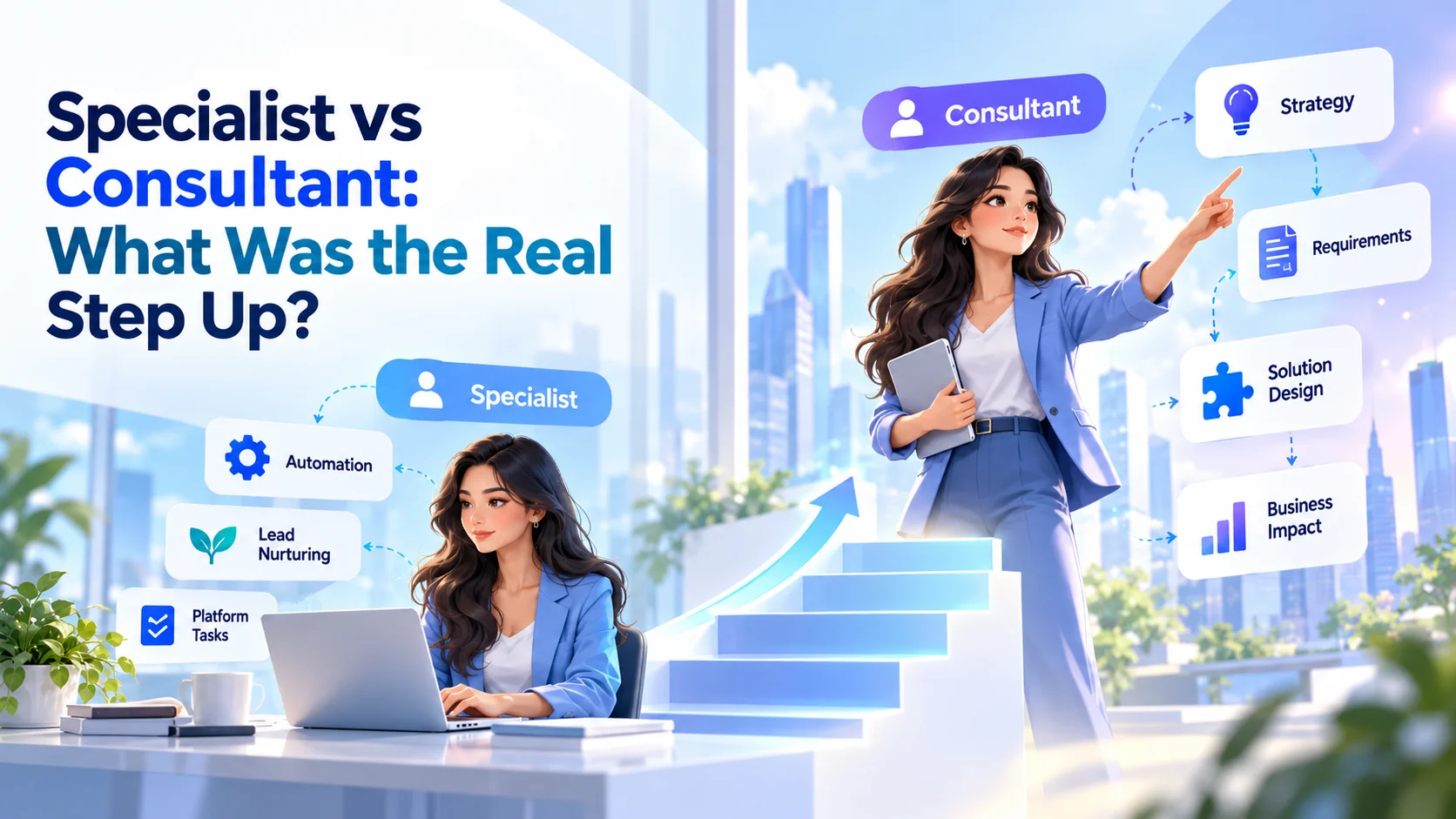
Specialist vs Consultant: What Was the Real Step Up?
| Specialist Thinking | Consultant Thinking |
| How does this feature work? | Should we use this feature for this requirement? |
| How do I create an automation? | Which automation approach is most scalable? |
| How do I manage prospects? | How should the lead lifecycle be designed? |
| How do I build a nurture program? | What nurture strategy matches the sales cycle? |
| How do I configure scoring? | What behavior should indicate buying intent? |
| How do I create reports? | Which metrics demonstrate business performance? |
| How do I configure Account Engagement? | How should the overall implementation be structured? |
This distinction explains why hands-on experience was so important.
A Consultant was expected to look at the entire marketing and sales process rather than treat each Account Engagement feature separately.
Who Was the Consultant Certification Designed For?
The Marketing Cloud Account Engagement Consultant certification was particularly relevant for professionals working in roles such as:
- Account Engagement Specialists
- Salesforce marketing consultants
- Marketing automation consultants
- Salesforce administrators working with marketing teams
- Account Engagement administrators
- B2B marketing technology professionals
- Implementation consultants
- Salesforce professionals moving into solution design
Salesforce recommended significant practical experience with Account Engagement and Salesforce before attempting the Consultant exam. The exam guide referenced approximately 12 months or more of hands-on implementation and administration experience.
The certification was therefore not designed simply as the next test to take. It represented a progression from performing tasks to designing solutions.
Professionals comparing this path with other Salesforce credentials can explore the complete Salesforce certification list, which organizes certifications across consultant, administrator, architect, developer, marketing, Agentforce, and other categories.
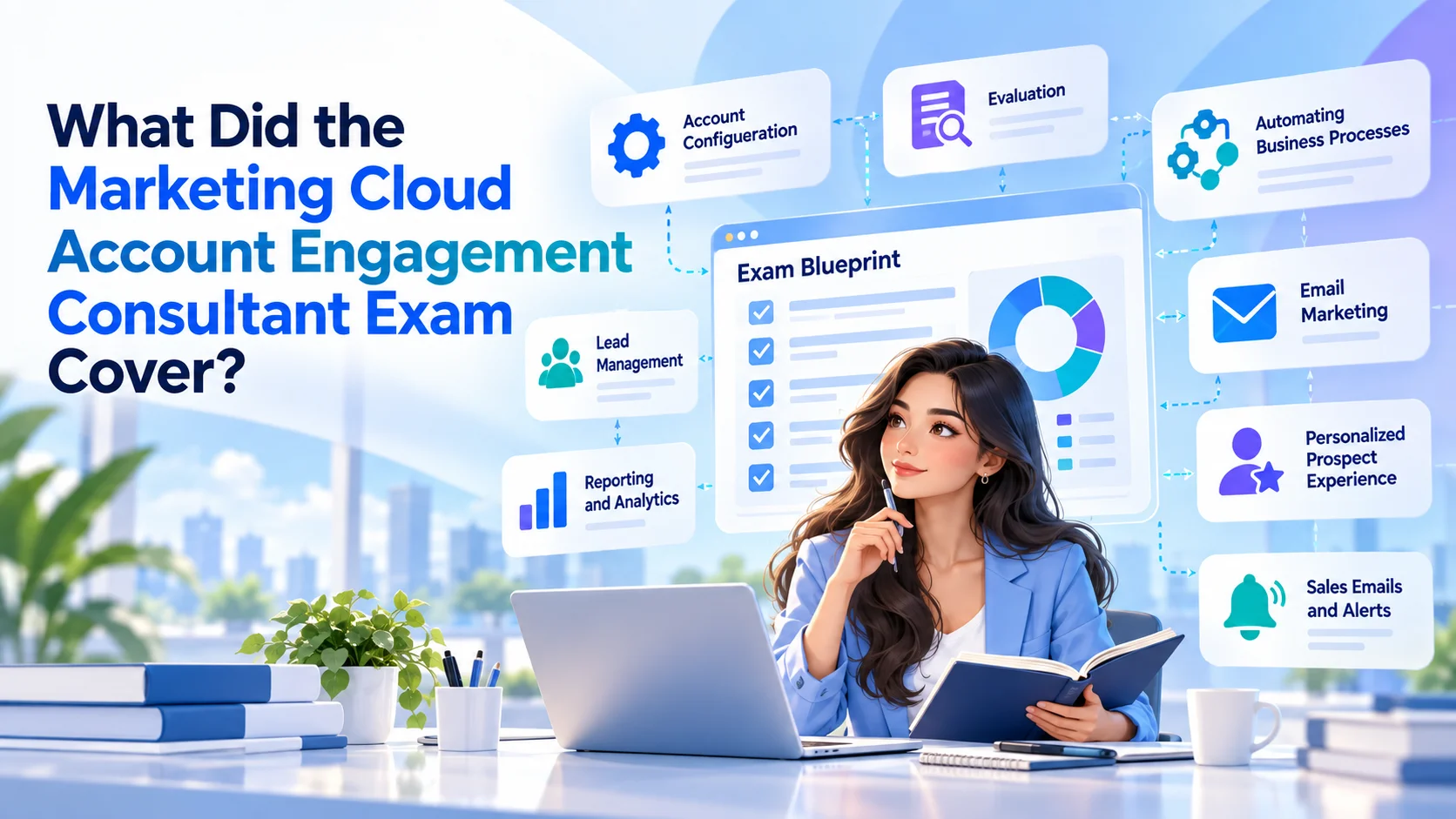
What Did the Marketing Cloud Account Engagement Consultant Exam Cover?
Before exam delivery ended, the Consultant exam included 60 scored multiple-choice or multiple-select questions, with the possibility of additional unscored questions.
Candidates received 105 minutes, and the passing score was 68%. The Marketing Cloud Account Engagement Specialist credential was a prerequisite.
The official blueprint included:
- Account Configuration – 20%
- Evaluation – 17%
- Automating Business Processes – 17%
- Lead Management – 14%
- Reporting, Metrics and Analytics – 11%
- Email Marketing – 10%
- Personalizing the Prospect Experience – 8%
- Sales Emails and Alerts – 3%
The weighting shows how heavily the certification emphasized configuration, evaluation, automation, and lead management.
It also explains why candidates needed practical experience rather than relying only on feature definitions and memorization.
Moving From Feature Knowledge to Solution Thinking
Suppose a company wants marketing to send better-qualified leads to its sales team.
A Specialist might understand scoring, grading, completion actions, automation rules, dynamic lists, and Engagement Studio.
A Consultant would need to ask a different set of questions:
- What does a sales-ready lead mean for this company?
- Which activities demonstrate meaningful engagement?
- Which demographic or firmographic attributes indicate a good fit?
- Should qualification depend on score, grade, or both?
- What happens to leads that are interested but not ready for sales?
- How should qualified leads be assigned?
- Which nurture journeys should continue for unqualified prospects?
- What information should sales representatives receive?
- How will the company measure whether the process is successful?
This shift from feature knowledge to solution thinking was at the heart of the Consultant certification.
It is also one of the most valuable skills to retain even after the credential itself retires.
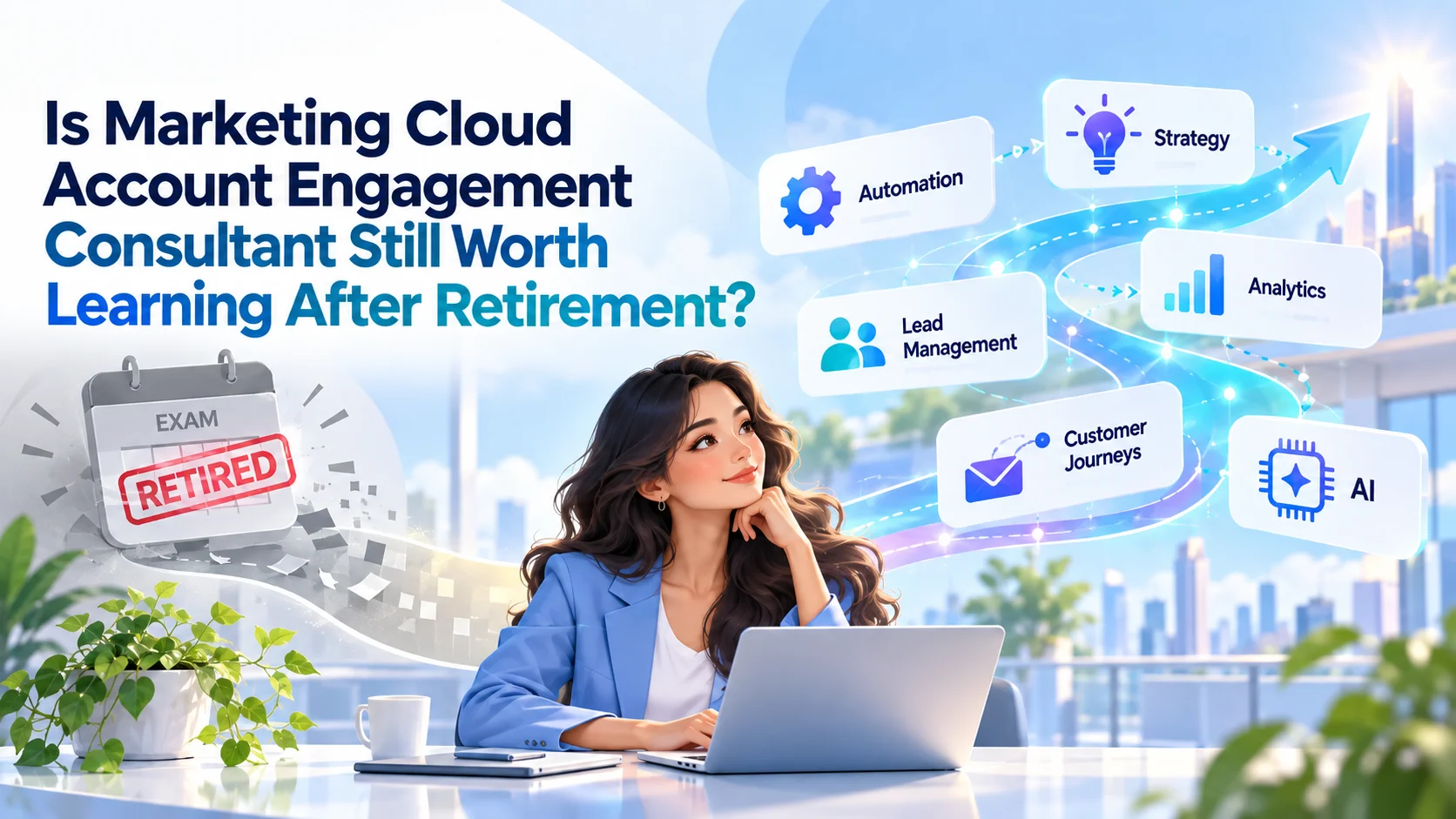
Why is the Account Engagement Consultant Certification Retiring?
Salesforce has confirmed the following retirement schedule:
- Last day to register: July 24, 2026
- Last day to take the exam: August 31, 2026
- Official certification retirement: February 1, 2027
Because August 31, 2026 has passed, new candidates can no longer schedule this certification exam.
The change is part of a broader evolution of the Salesforce certification ecosystem as newer products, AI capabilities, Agentforce, and updated role-based credentials become more important.
Is Marketing Cloud Account Engagement Consultant Still Worth Learning After Retirement?
The exam is retiring, but the skills behind it remain useful.
Understanding how to translate business requirements into Account Engagement solutions continues to matter for organizations using Salesforce for B2B marketing automation.
Professionals still need to know how to:
- Design lead qualification models
- Connect marketing processes with sales workflows
- Build maintainable automation
- Plan nurture strategies
- Improve data quality
- Design reporting frameworks
- Manage prospect experiences
- Evaluate business requirements before selecting features
Salesforce has also made clear that retiring a certification does not mean the expertise represented by that credential suddenly loses its value.
For new learners, there is little reason to study specifically for an exam that can no longer be taken. However, studying the underlying consulting concepts can still help develop stronger Account Engagement and Salesforce marketing skills.
What Comes After Account Engagement Consultant?
This is one of the most important questions for professionals planning their next step.
Salesforce has said it is assessing skills previously tested by the Marketing Cloud Account Engagement Consultant certification for possible incorporation into an upcoming Agentforce Marketing certification.
This reflects the wider direction of the Salesforce ecosystem, where marketing automation, customer data, CRM, AI, and Agentforce are increasingly connected.
Instead of focusing only on the old certification path, Account Engagement professionals should consider expanding their knowledge into areas such as:
- Agentforce
- AI-assisted marketing
- Data 360
- Marketing automation architecture
- Salesforce CRM integration
- Customer data management
- Marketing analytics
- Consent and privacy
- Cross-channel marketing
- Business requirements analysis
The certification names may change, but the ability to understand a customer’s requirements and design an appropriate Salesforce solution remains valuable.
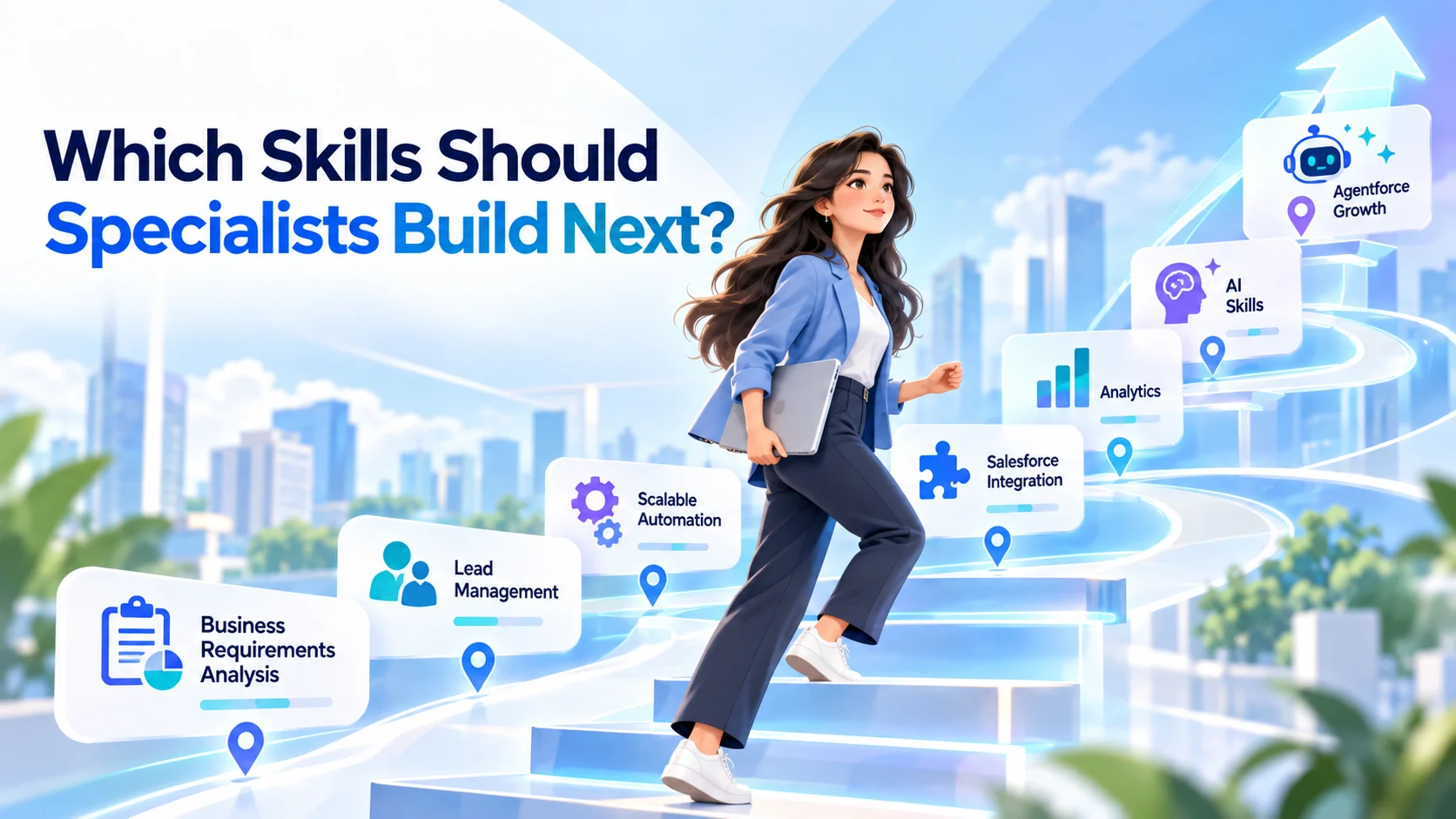
Which Skills Should Specialists Build Next?
If you already have Specialist-level Account Engagement knowledge, focus on developing the skills that separated a consultant from a platform user.
- Business Requirements Analysis
Learn how to turn a marketing team’s objectives into clear Salesforce requirements rather than immediately choosing a feature.
Ask what the business is trying to achieve before deciding how Account Engagement should be configured.
- Lead Management
Understand the complete journey from prospect acquisition and nurturing to qualification, assignment, sales follow-up, and reporting.
Strong lead management knowledge means understanding both the marketing and sales sides of the process.
- Scalable Automation
Knowing how to create an automation rule is only the beginning.
You should also understand how to prevent overlapping automation, unnecessary complexity, conflicting rules, and processes that become difficult to maintain as the organization grows.
- Salesforce Integration
Understand how Account Engagement interacts with Salesforce records, campaigns, users, leads, contacts, sales processes, and reporting.
A good marketing solution rarely operates completely independently from the CRM.
- Analytics
Learn which metrics demonstrate whether marketing activity is producing meaningful business results.
Instead of reporting only opens, clicks, or form submissions, think about how marketing activity contributes to lead quality, pipeline, conversion, and revenue.
- AI and Agentforce
Pay close attention to Salesforce’s expanding use of AI across marketing.
If Account Engagement consulting skills become part of future Agentforce-focused marketing credentials, professionals who understand both traditional marketing automation and AI-driven workflows will be better prepared for the changing ecosystem.
Final Thoughts
Moving from Marketing Cloud Account Engagement Specialist to Consultant was never simply about passing a more difficult exam.
It represented a change in how you approached the platform.
A Specialist needed to understand how Account Engagement features work.
A Consultant needed to understand when, why, and how those features should be combined to solve a customer’s business requirements.
The Consultant exam is no longer available to new candidates, and the credential officially retires on February 1, 2027. However, the consulting skills behind it remain relevant.
For today’s Account Engagement professionals, the next step is bigger than moving from one certification badge to another. Build expertise in requirements analysis, scalable automation, lead management, Salesforce integration, analytics, customer data, and Agentforce. Those skills can help you move from someone who simply uses Account Engagement to someone who can design effective Salesforce marketing solutions.