
A healthcare system can work exactly as configured and still create a frustrating experience for the patient.
Imagine someone trying to find a specialist. The provider search works, records load correctly, and the available filters return results. Yet the patient cannot easily tell which providers meet their needs, which facility is convenient, or what they should do next.
Technically, the feature works. For the patient, the problem may still be unresolved.
That difference explains why patient-centered design matters when studying Salesforce healthcare solutions. The Health Cloud Accredited Professional exam, now officially called the Salesforce Accredited Agentforce Health Professional exam, tests the skills needed to discover requirements, design healthcare solutions, implement them, and prepare them for deployment.
Salesforce renamed the credential on July 24, 2026 as part of a broader certification naming update. Salesforce states that the name change itself did not change the underlying exam content or maintenance requirements. Health Cloud has also been renamed Agentforce Health, although Salesforce notes that references to Health Cloud can still appear in its applications and documentation.
For candidates, the important lesson goes beyond terminology. Healthcare technology should not only function correctly. It should support the people who depend on it.
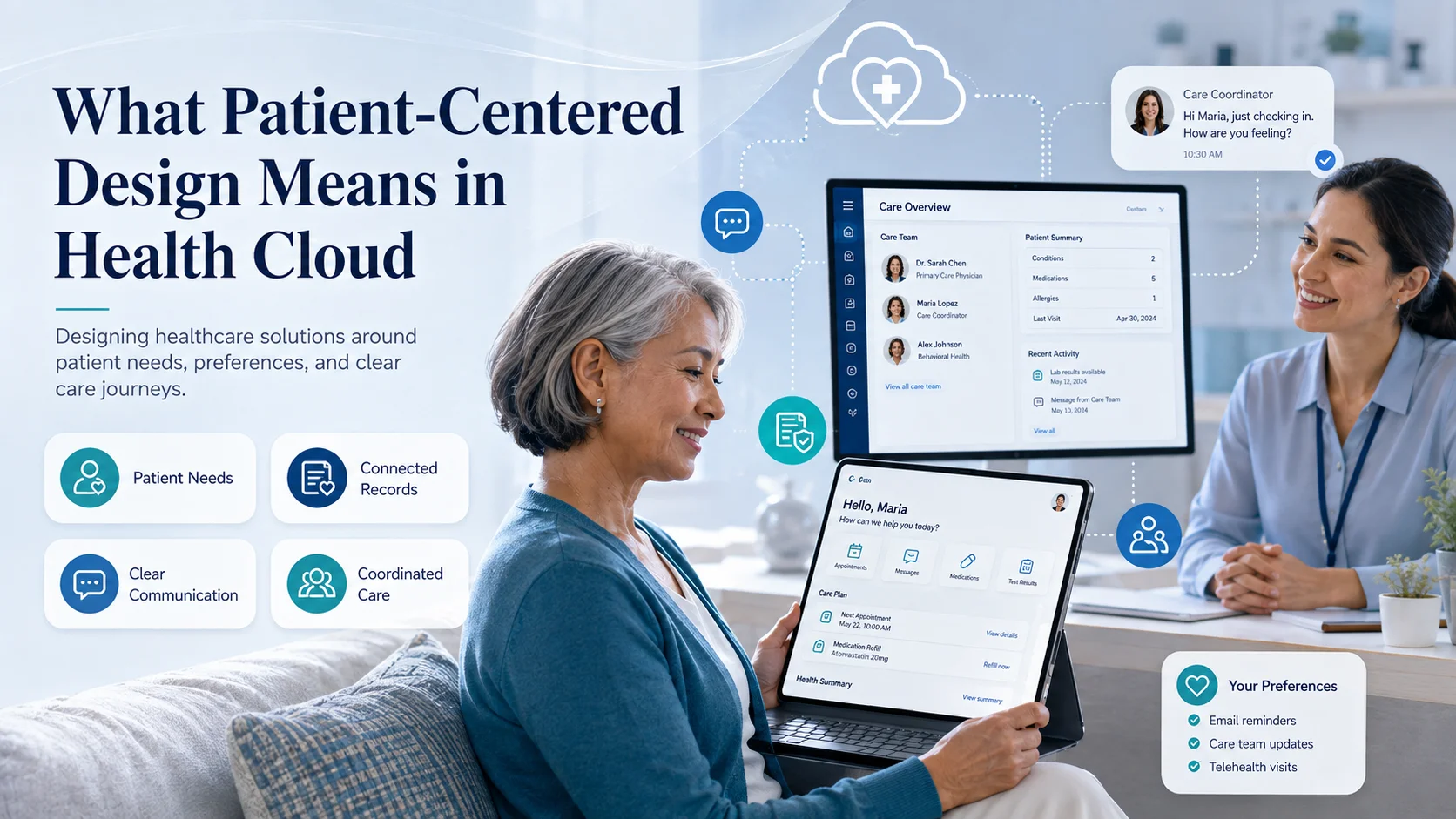
What Patient-Centered Design Means in Health Cloud?
Patient-centered design begins with the needs of the patient rather than the convenience of the system.
The Institute of Medicine’s Crossing the Quality Chasm identified patient-centeredness as one of six aims for improving healthcare, together with safety, effectiveness, timeliness, efficiency, and equity. Its definition focuses on respecting individual patient preferences, needs, and values.
That principle has practical consequences for healthcare technology.
When an organization designs an Agentforce Health solution, useful questions include:
- Can the patient find the information they need?
- Is information being requested more than once?
- Can staff see enough context to help the patient efficiently?
- Are patient preferences reflected in the process?
- Is the next step clear?
- Does the solution reduce effort or simply move that effort somewhere else?
These questions are closely related to the discovery and design decisions that healthcare consultants make.
Patient Data Should Reduce Repetition
Agentforce Health can bring together information about patients or members and the people involved in their care. Salesforce describes the platform as providing a broad view that can include physicians, care team members, family members, and other participants.
The value of that data depends on how it is used.
Consider a patient who has already supplied personal information and medical details to one part of an organization. If another team cannot access the appropriate information, the patient may have to repeat it.
The technical cause could involve data modeling, integration, permissions, or the way information moves between systems.
The patient experiences something much simpler:
“Why do I need to provide this again?”
Good design considers both sides of the problem. The information must be accurate, secure, and available to authorized users, but it should also help reduce unnecessary effort.
This perspective can also help candidates work through Health Cloud Accredited Professional exam questions. When a question involves patient data, integration, security, or healthcare objects, consider what the information is meant to accomplish before choosing a solution.
Provider Information Should Help People Make Decisions
Provider data is another useful example.
A system may contain accurate records for providers, facilities, specialties, and related healthcare information. That does not automatically mean the information is useful to the person searching for care.
A patient usually has a specific need. They may be trying to identify a suitable specialist, locate a convenient facility, or find a provider who matches particular requirements.
The implementation question should therefore be more specific than:
Can the system return provider records?
A better question is:
Does the information presented help the person make the decision they came to make?
Salesforce’s current Agentforce Health documentation includes healthcare capabilities related to patients, members, providers, facilities, care services, and provider matching. The quality of an implementation depends on how those capabilities are connected to the organization’s actual requirements.
This is why understanding the healthcare scenario is often more valuable than memorizing the name of a feature.
Care Coordination Should Feel Coordinated
A healthcare organization may have well-defined internal processes while still appearing fragmented to a patient.
One team may request information another team already collected. Two departments may contact the patient about the same issue. A patient may receive instructions without knowing who owns the next step.
Each individual process might be functioning as configured.
The overall experience can still be poor.
Patient-centered care coordination requires the implementation team to consider the journey across teams and processes.
Questions worth asking include:
- What has already happened?
- Who owns the next action?
- What information does that person need?
- Can another team see that the work has already been completed?
- Does the patient understand what happens next?
These are business-process questions, but they have direct consequences for solution design.
Patient Preferences Should Have a Purpose
Healthcare systems can collect large amounts of information that never meaningfully affects the experience.
Suppose a patient’s communication preference is recorded correctly, but the organization continues using the same channel for every interaction. The data exists, but the preference has not changed the process.
Consent raises a similar question.
It is not enough to know that consent information can be recorded. An implementation team needs to understand how consent affects access, communication, sharing, or another part of the workflow.
Patient-centered design asks a useful follow-up:
What should happen because this information exists?
This way of thinking is especially valuable for scenario-based certification preparation. Rather than learning objects and features as separate facts, candidates can study the relationships between data, requirements, security, processes, and outcomes.
Digital Access Does Not Remove Every Barrier
Digital healthcare services can make many tasks easier. Patients may be able to access information, manage parts of their care, communicate with healthcare organizations, or complete processes without unnecessary phone calls or visits.
The experience will not be identical for every person.
People differ in digital confidence, language ability, health literacy, available devices, internet access, vision, and familiarity with online services.
This does not mean a Salesforce consultant is responsible for solving every accessibility or health-equity issue.
It does mean that implementation teams should avoid assuming that every user will interact with a process in the same way.
If an important healthcare process depends on one digital path, discovery should consider what happens when a patient cannot successfully complete that path.
That is a practical design question, not an abstract one.
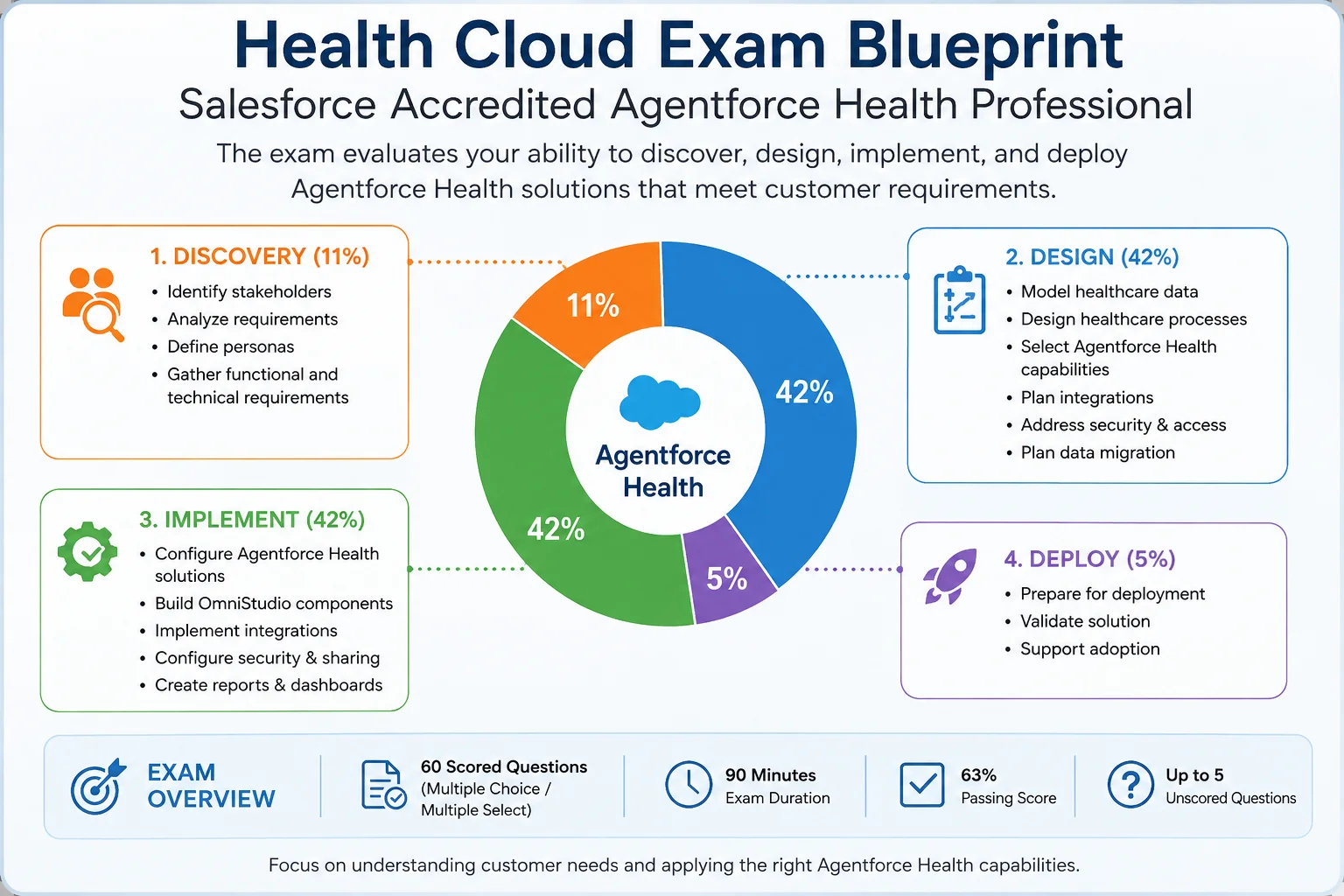
How Patient-Centered Design Connects to the Current Exam Blueprint?
The current official Salesforce Accredited Agentforce Health Professional exam guide divides the exam into four areas:
| Exam area | Weight |
| Discovery | 11% |
| Design | 42% |
| Implement | 42% |
| Deploy | 5% |
Design and implement together account for 84% of the published exam blueprint.
That makes practical decision-making particularly important.
In Discovery, candidates are expected to identify personas and stakeholders, analyze required capabilities, and gather functional and technical requirements based on customer outcomes.
Design covers areas such as modeling patients, providers, and healthcare facilities, selecting appropriate Agentforce Health capabilities, planning integrations, addressing security and data access, defining future-state processes, and developing migration strategies.
Implement focuses on configuring Agentforce Health solutions, OmniStudio components, integrations, security, sharing, visibility, and reporting.
Patient-centered design is not listed as a separate exam domain. However, understanding the people affected by a requirement can provide useful context for many of the scenarios within the published objectives.
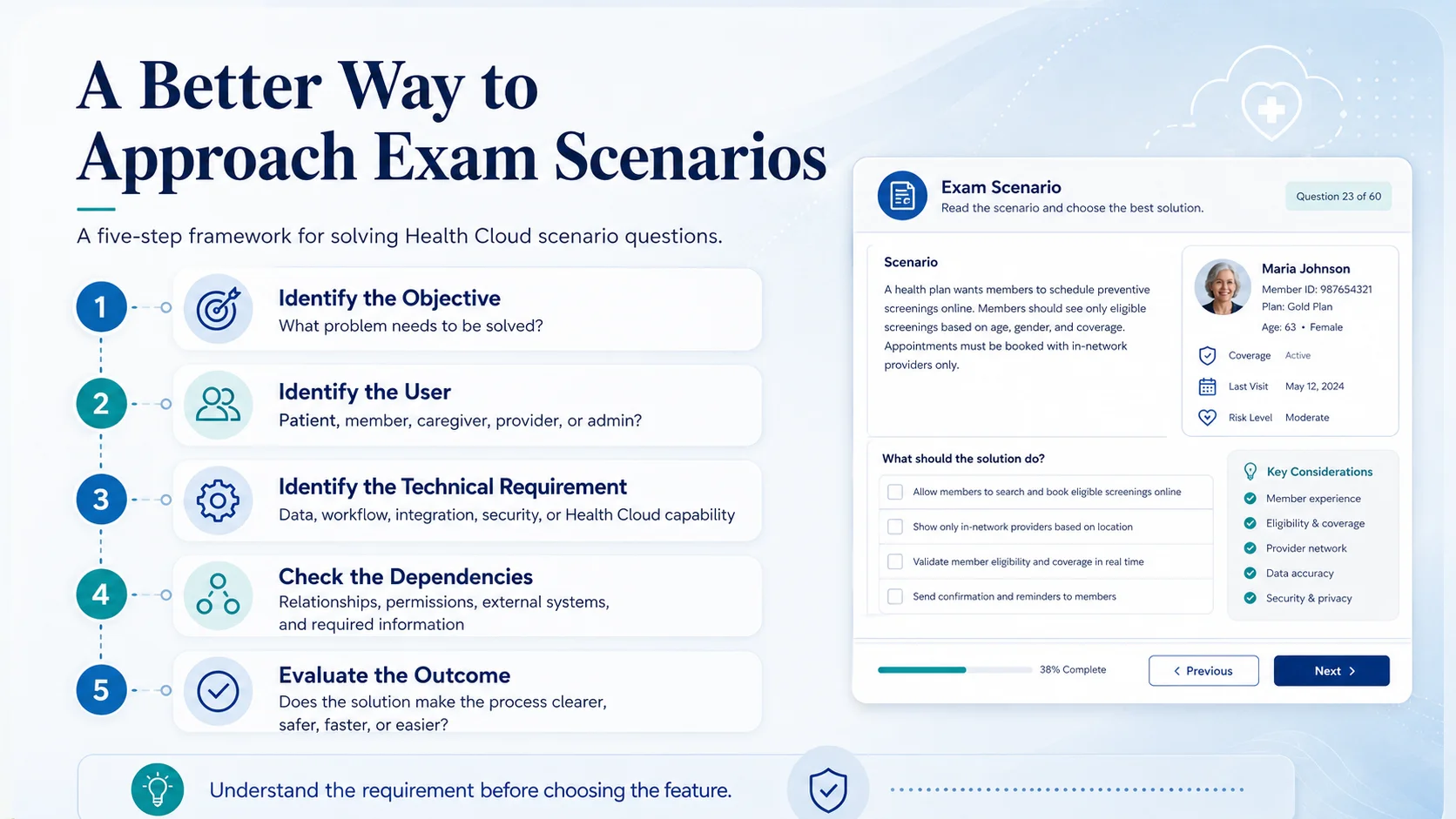
A Better Way to Approach Exam Scenarios
Salesforce’s exam guide makes it clear that candidates are expected to apply their knowledge to customer requirements and scenarios.
A useful approach is to work through each scenario in five steps:
- Identify the desired outcome. What problem is the customer trying to solve?
- Identify the people involved. Is the requirement mainly affecting a patient, member, provider, care coordinator, administrator, or another stakeholder?
- Find the technical requirement. Determine whether the scenario concerns data, integration, security, workflow, reporting, or another Agentforce Health capability.
- Check the dependencies. Consider the information, relationships, permissions, and external systems needed for the solution.
- Evaluate the result. Does the proposed solution meet the stated customer requirement without creating unnecessary complexity?
This method encourages understanding rather than isolated memorization.
Candidates who want a structured preparation schedule can also use the 30-day Salesforce exam study plan and combine it with the official exam guide, hands-on practice, and scenario review.
For candidates using Trailhead, the Salesforce Trailhead certification preparation guide provides another way to organize hands-on learning around exam objectives.
What the Exam Can and Cannot Prove?
A certification exam has a defined purpose.
The Salesforce Accredited Agentforce Health Professional exam is designed to assess whether a candidate can design and implement Agentforce Health solutions that meet customer business requirements and follow Salesforce practices.
It is not a certification in clinical care, patient communication, usability testing, or health-equity assessment.
Passing the exam therefore does not prove that every future implementation will provide an excellent patient experience.
That does not reduce the value of the credential. It clarifies what the credential demonstrates.
A qualified implementation professional still needs to understand the organization’s users, workflows, technical constraints, healthcare requirements, and desired outcomes.
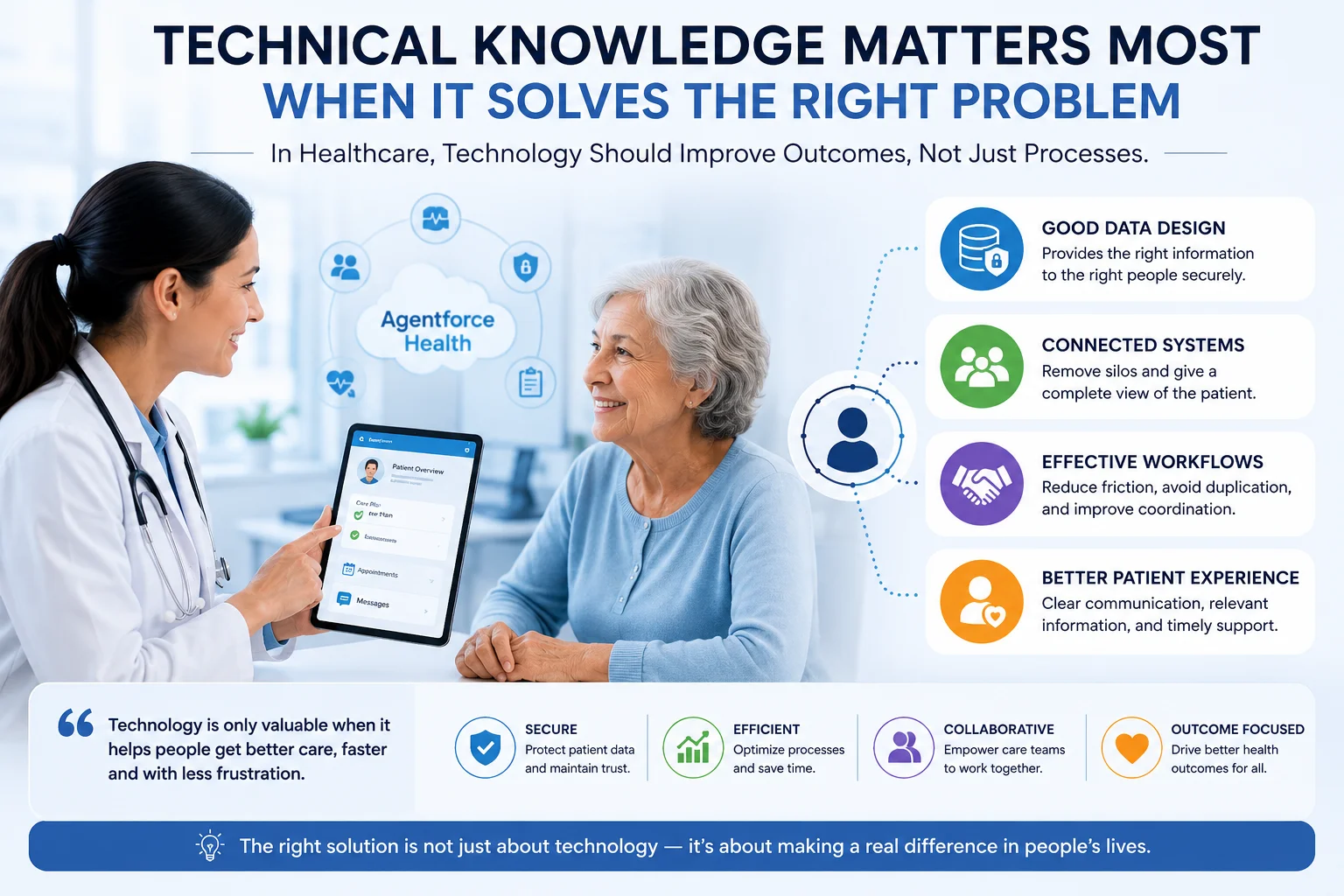
Technical Knowledge Matters Most When It Solves the Right Problem
Healthcare technology exists inside real care experiences.
Good data design can reduce unnecessary repetition. Connected systems can make information available where it is needed. Thoughtful provider information can support better decisions. Clear workflows can reduce confusion between teams. Proper handling of preferences and consent can make healthcare interactions more appropriate for the individual.
These outcomes depend partly on technical choices.
That is why patient-centered design is a useful lens for Health Cloud Accredited Professional exam preparation. It connects Salesforce concepts with the healthcare requirements they are intended to support.
Candidates should learn the official objectives, understand Agentforce Health functionality, practice applying the concepts to customer scenarios, and use the current Salesforce exam guide as the primary source for exam details.
At the same time, one question is worth carrying from certification preparation into real implementation work:
Does this solution solve the problem for the people who will actually use it?
Knowing how to configure the platform is important.
Understanding why a particular configuration serves the healthcare requirement is what turns technical knowledge into sound solution design.