
The Salesforce Certified Sales Cloud Consultant Exam is designed to test far more than feature familiarity. Candidates are expected to evaluate business requirements, recommend scalable solutions, and prioritize long-term usability within complex sales environments. That is why many otherwise capable Salesforce professionals struggle with the exam: the questions are intentionally structured to expose weak consulting judgment rather than missing technical knowledge.
Most articles about this certification focus on memorizing features, reviewing terminology, or listing topics from the exam guide. However, the real challenge lies in understanding how Salesforce expects consultants to think. The exam repeatedly rewards candidates who can balance business outcomes, platform limitations, maintainability, and user adoption simultaneously.
This article examines the most common traps found in Sales Cloud Consultant Exam Questions and explains how to avoid them using consultant-level reasoning rather than rote memorization.

Why the Salesforce Certified Sales Cloud Consultant Exam is Challenging?
The Salesforce Certified Sales Cloud Consultant Exam differs from administrator-oriented certifications because many questions contain multiple technically valid answers. The objective is not simply identifying what Salesforce can do, but determining which solution is most appropriate in a real business environment.
The exam typically evaluates whether candidates can:
- Align technology with sales processes
- Recommend scalable solutions
- Reduce administrative complexity
- Improve sales productivity
- Support long-term governance
- Encourage user adoption
This creates a different kind of difficulty. Candidates who rely entirely on memorization often struggle because the exam prioritizes decision-making over recall.
Trap #1: Choosing Overengineered Solutions
One of the most common mistakes in Sales Cloud Consultant Exam Questions is assuming that the most technically advanced solution is automatically the best choice.
Salesforce consulting generally follows this hierarchy:
- Use standard functionality first
- Prefer declarative tools over code
- Minimize maintenance requirements
- Avoid unnecessary customization
The exam consistently reflects these priorities.
Example Scenario
A question may describe a company that needs:
- Lead routing
- Territory-based assignment
- Basic exception handling
Many candidates immediately choose Apex development because it appears more flexible.
However, the better answer is often:
- Lead Assignment Rules
- Queues
- Flow automation
- Territory Management configuration
The trap works because Salesforce exams reward scalability and maintainability, not technical complexity.
When reviewing a Salesforce Certified Sales Cloud Consultant Practice Test, candidates should ask:
“Would this solution still be manageable two years from now with minimal administrative overhead?” That question often reveals the correct answer.

Trap #2: Focusing on Symptoms Instead of Business Problems
Many candidates answer questions based on surface-level requirements while ignoring the underlying business objective.
For example, a scenario may mention:
- Inaccurate forecasting
- Poor pipeline visibility
- Executive reporting complaints
Candidates often select answers involving dashboards or analytics enhancements.
But the real issue may be:
- Inconsistent opportunity stages
- Weak sales process enforcement
- Lack of required field validation
- Poor data quality
The exam frequently rewards candidates who identify the root operational problem rather than reacting to visible symptoms.
Experienced consultants understand that reporting issues are often caused by process failures upstream.
Trap #3: Ignoring Keywords That Define the Correct Answer
The wording of Sales Cloud Consultant Exam Questions is extremely precise. Small phrases often determine which answer Salesforce considers best.
Important keywords include:
| Keyword or Phrase | What It Usually Signals |
| Minimal maintenance | Declarative configuration |
| Most scalable | Standardized architecture |
| Improve adoption | Simpler user experience |
| Global sales organization | Territory and role considerations |
| Real-time visibility | Automation and reporting alignment |
| Large data volume | Performance-aware design |
| Fast implementation | Out-of-the-box functionality |
Candidates who skim questions often choose answers that are technically correct but strategically misaligned with the stated priority.
Careful reading is one of the most underrated exam skills.
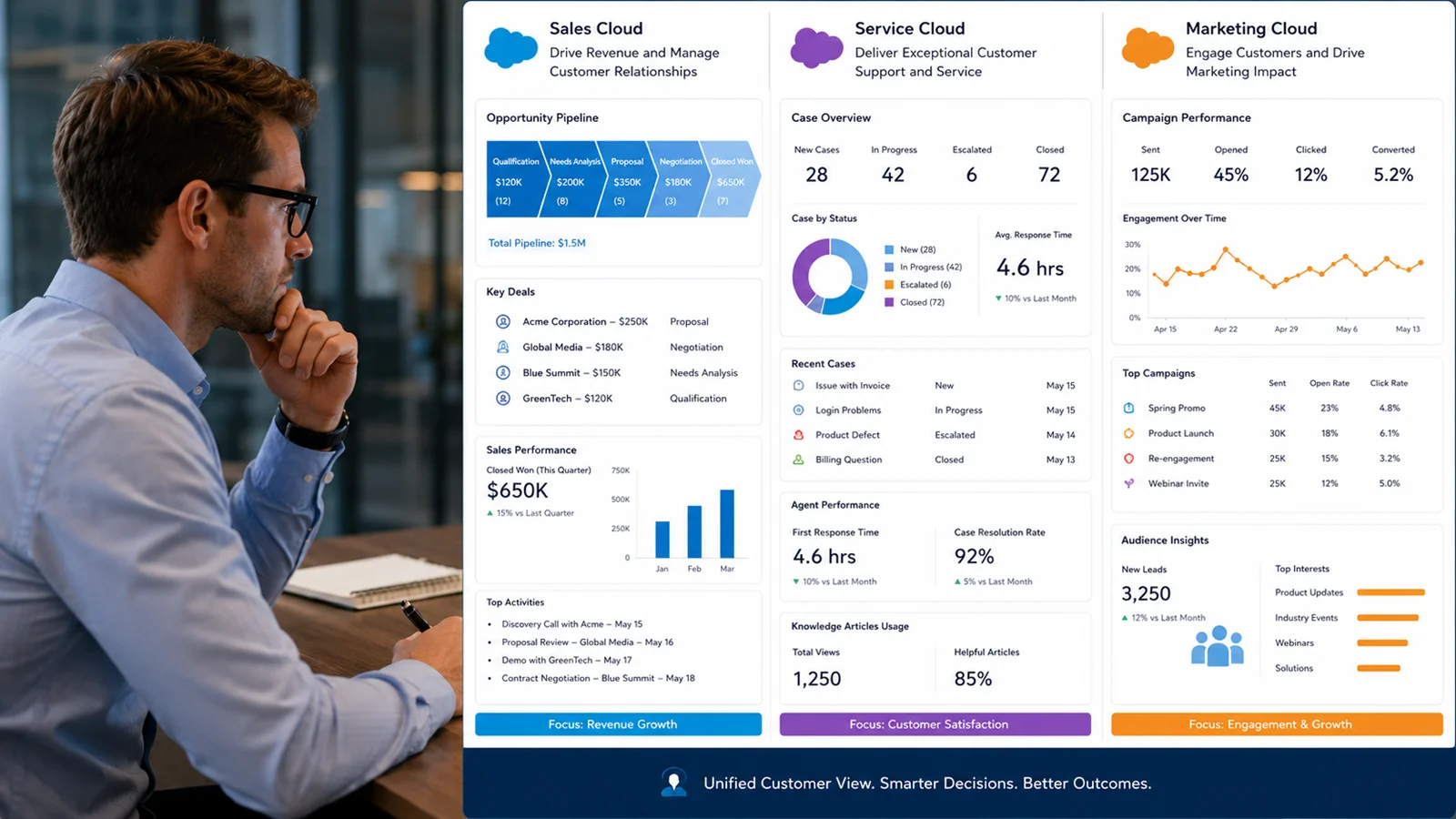
Trap #4: Confusing Sales Cloud with Other Salesforce Products
Another frequent issue is selecting functionality associated with other Salesforce clouds.
The exam expects candidates to distinguish clearly between:
- Sales Cloud capabilities
- Service Cloud processes
- Marketing-related functionality
For example:
- Case escalation is primarily associated with Service Cloud
- Opportunity pipelines belong to Sales Cloud
- Marketing attribution involves campaign and reporting strategy
Distractor answers are often intentionally believable. A candidate who understands business process ownership across Salesforce products is far less likely to fall into this trap.
Trap #5: Ignoring User Adoption and Sales Productivity
The exam strongly emphasizes user adoption because poorly adopted CRM systems create unreliable forecasts, weak reporting, and inconsistent sales execution.
Candidates sometimes choose answers that maximize administrative control but reduce usability.
Example
A company wants sales representatives to update opportunities consistently.
Weak consulting answer:
- Make every field mandatory
Better consulting answer:
- Use Path
- Add Guidance for Success
- Simplify page layouts
- Reduce unnecessary data entry
The exam repeatedly rewards solutions that improve productivity while still supporting governance.
This reflects real-world Salesforce consulting, where adoption is often more important than feature depth.

Trap #6: Treating Automation Tools as Interchangeable
Many candidates memorize automation features without understanding when each tool is strategically appropriate.
The exam tests whether candidates can match the right tool to the right business need.
Common Examples:
| Requirement | Preferred Approach |
| Lead routing | Assignment Rules |
| Guided approvals | Approval Processes |
| Sales stage coaching | Path |
| Field automation | Flow |
| Forecast collaboration | Collaborative Forecasts |
The incorrect options are often technically possible but operationally inefficient.
That distinction matters because Salesforce consulting is fundamentally about designing sustainable business systems, not simply creating functional automation.
Trap #7: Falling for Unrealistic “Perfect Data” Assumptions
Many wrong answers assume:
- Perfect user discipline
- Clean CRM data
- Unlimited administrative resources
- Consistent manual compliance
Real organizations rarely operate this way, and neither does the exam.
The strongest answers usually:
- Reduce manual dependency
- Improve process consistency
- Simplify governance
- Support scaling across teams
This is one of the clearest differences between platform knowledge and consulting judgment.

How to Approach the Exam More Effectively?
Candidates who consistently perform well on the Salesforce Sales Cloud Consultant Exam usually follow a structured reasoning process:
1. Identify the Core Business Objective
Separate critical requirements from distracting details.
2. Prioritize Standard Salesforce Functionality
Salesforce strongly favors maintainable declarative solutions.
3. Consider Long-Term Scalability
The best solution should still work effectively as the organization grows.
4. Evaluate User Impact
Poor adoption weakens even technically correct implementations.
5. Eliminate “Possible but Poor” Answers
Many distractors are functional but strategically weak.
This approach is far more effective than repeatedly taking a Salesforce Certified Sales Cloud Consultant Practice Test without understanding the reasoning behind the correct answers.
Also read:
How to Stay Motivated During Salesforce Data Cloud Consultant Certification Prep?
Avoid These Common Mistakes in Salesforce Data Cloud Consultant Exam Prep