
Large ecommerce projects need more than developers who build storefront features. Someone also has to decide how storefronts, customer data, payments, order systems, external services, performance, and future growth fit together. That is where a commerce architect comes in.
The Salesforce Certified B2C Commerce Architect certification was created to validate this broader level of technical decision-making. It focused on professionals who could design scalable ecommerce solutions, guide development teams, plan integrations, and support a B2C Commerce implementation from discovery through launch.
For beginners exploring Salesforce architecture, this certification provides a useful picture of what advanced commerce architecture involves. There is also an important update for 2026: the exam is no longer available to new candidates, and the certification will officially retire on February 1, 2027.

What Is the B2C Commerce Architect Certification?
The B2C Commerce Architect certification focused on enterprise ecommerce solutions built with Salesforce B2C Commerce.
Salesforce designed it for professionals capable of working with global sites, multiple brands and channels, integrations, performance requirements, security, and reusable architecture patterns.
A developer may concentrate on implementing an individual feature. An architect needs to consider how that feature affects the wider solution, including data flows, integrations, scalability, maintenance, and business objectives.
Salesforce now refers to B2C Commerce as Agentforce Commerce for B2C, although you will still find the older B2C Commerce name throughout documentation and Trailhead content.
What Does a B2C Commerce Architect Do?
A B2C Commerce architect connects business requirements with technical design.
Consider a retailer that operates ecommerce sites across several countries. Each market could require different currencies, languages, catalogs, payment providers, tax services, shipping systems, and order-management processes.
The architect decides how those components should interact while keeping the solution scalable and manageable.
The role can involve documenting technical requirements, designing integrations, reviewing implementation decisions, planning deployments, supporting testing, investigating performance problems, and helping development teams resolve complex technical issues. Salesforce’s current learning material places technical architects throughout discovery, design, build, integration, testing, and launch.
Architecture also involves making trade-offs. For example, should inventory be requested from an ERP system every time a shopper views a product, or should inventory data be synchronized periodically?
Real-time access could provide fresher information, but it also makes the storefront more dependent on an external service. The best approach depends on traffic, performance requirements, reliability, and business needs.
This type of decision-making is at the heart of commerce architecture.

Who Was the Certification Designed For?
B2C Commerce Architect was an advanced certification, not an entry point for someone completely new to Salesforce.
Salesforce described typical candidates as experienced ecommerce professionals who already held the Salesforce Certified B2C Commerce Developer credential. The official exam guide generally recommended five or more years of ecommerce experience.
Candidates also needed familiarity with Storefront Reference Architecture, or SFRA, along with security, performance, integrations, replication, and multi-site implementations. Knowledge of systems such as CRM, ERP, order management systems, product information management systems, and warehouse management systems was also relevant.
For beginners, this certification is better viewed as an example of where a Salesforce commerce career could eventually lead.
What Was the B2C Commerce Architect Exam Format?
Before the exam closed, Salesforce listed 60 multiple-choice and multiple-select questions, plus up to five unscored questions.
Candidates had 105 minutes and needed a 65% passing score. The registration fee was US$400 plus applicable taxes, while the retake fee was US$200. The exam was closed book, and B2C Commerce Developer certification was a prerequisite.
For learners reviewing B2C Commerce Architect Certification Multiple Choice Questions today, the real value comes from understanding why one architectural solution fits a scenario better than another.
What Topics Did the Exam Cover?
The exam blueprint contained five main domains:
- Design and Discovery: 29%
- Integrations and Customizations: 22%
- Build: 19%
- Launch: 16%
- Monitoring and Troubleshooting: 14%
Design and Discovery received the highest weighting. Candidates had to translate business requirements into technical specifications, evaluate proposed solutions, consider future growth, and document integrations.
Other objectives included REST and SOAP integrations, batch and real-time processing, load testing, caching, logging, troubleshooting, deployment, replication, rollback planning, and post-launch monitoring.
The blueprint makes an important point for beginners: architecture is less about memorizing individual features and more about choosing appropriate solutions for specific requirements.
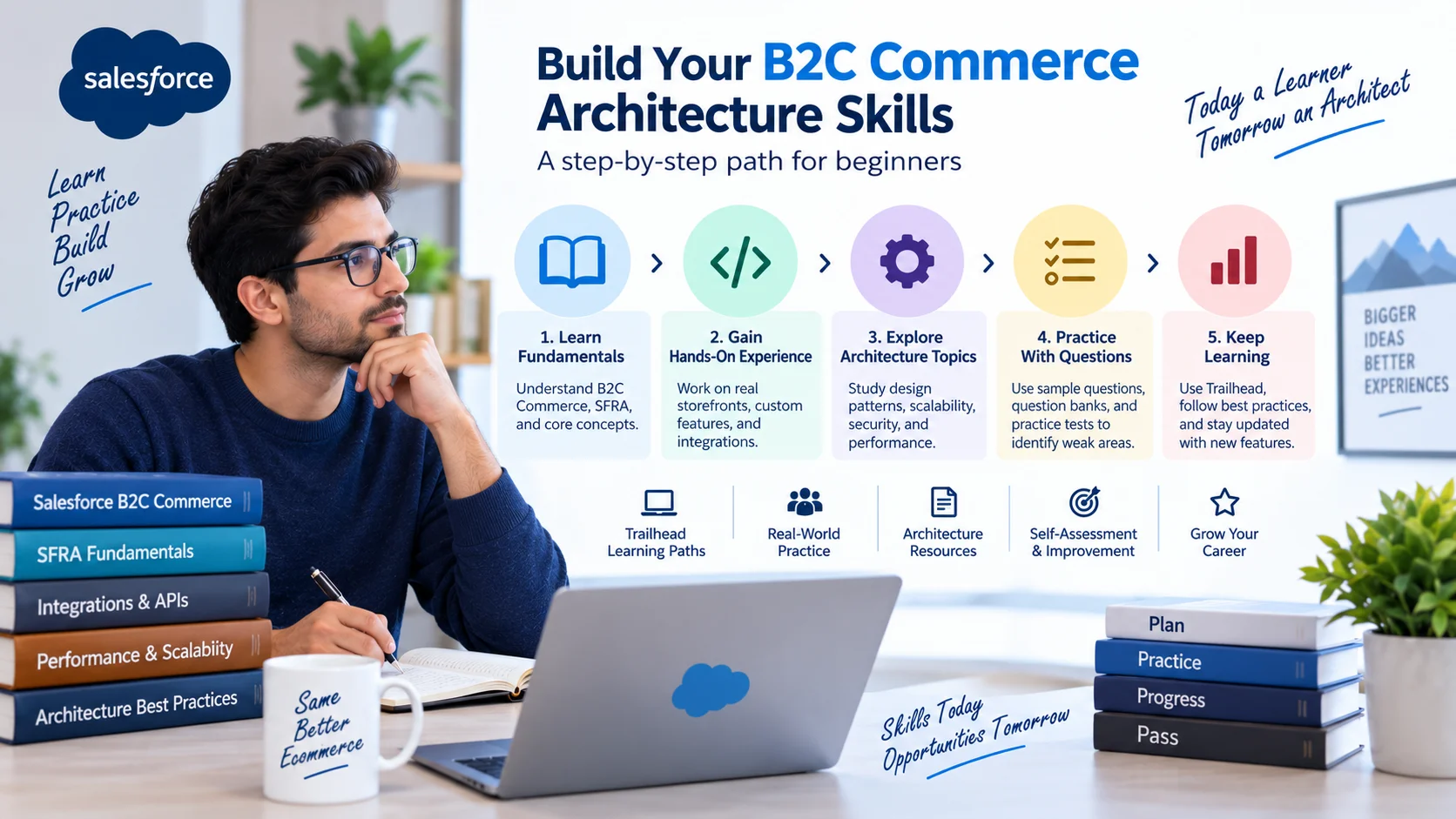
How Can Beginners Build B2C Commerce Architecture Skills?
Start with the fundamentals before moving into complicated architecture scenarios.
Salesforce still provides a dedicated B2C Commerce Technical Architect Trail. It covers technical project documentation, build processes, unit testing, performance analysis, and monitoring. Salesforce describes the goal as designing high-performing B2C Commerce sites that scale through well-designed integrations.
Once you understand the fundamentals, B2C Commerce Architect Certification Sample Exam Questions can help you apply concepts to realistic situations rather than simply memorize definitions.
A well-organized B2C Commerce Architect Certification Question Bank can then help identify weak areas. If you repeatedly struggle with integration scenarios, for example, you may need more work on APIs, external dependencies, synchronous processing, or scheduled data flows.
Taking a B2C Commerce Architect Certification MCQ Practice Test can provide another useful knowledge check. Since the exam has closed, however, practice tests should now be treated as self-assessment and learning resources rather than preparation for an upcoming exam appointment.
Is the B2C Commerce Architect Certification Retiring?
Yes.
Salesforce has confirmed that the certification will officially retire on February 1, 2027. The last day to register was July 24, 2026, while August 31, 2026 was the final day to take the exam. New candidates can therefore no longer earn the certification through an exam.
The retirement does not mean B2C Commerce architecture skills are disappearing. Salesforce continues to provide B2C Commerce technical architect training on Trailhead and currently uses the Agentforce Commerce for B2C name in newer learning content.
What Should Beginners Do Now?
If you are starting your Salesforce architecture journey in 2026, do not study for B2C Commerce Architect with the expectation of scheduling the old certification exam.
Instead, use its objectives as a roadmap.
Develop your knowledge of ecommerce fundamentals, SFRA, integrations, scalability, performance, security, testing, deployment, and technical documentation. More importantly, practice comparing different technical approaches and understanding the trade-offs behind each decision.
If you want to explore another Salesforce architect credential, our IAM Architect Exam guide provides a useful comparison with an active architecture path.
Final Thoughts
The B2C Commerce Architect certification represented the ability to see an ecommerce implementation as a complete system rather than a collection of isolated features.
Although its exam has closed and the certification is approaching retirement, the skills behind it remain relevant. For beginners, its scope still provides a useful introduction to how Salesforce commerce architects think, what decisions they make, and which technical abilities are worth developing as they progress toward an architecture career.