
Salesforce has introduced a major change to how businesses buy its CRM and Agentforce products. The company is rolling out three new editions called Core, Advanced, and Max, bringing CRM, Agentforce, Slack, analytics, security, and support into more consolidated packages.
Salesforce announced the changes on September 3, 2026, introducing the new editions across Agentforce Sales, Agentforce Service, and Agentforce Industries. You can read the official Salesforce announcement for Salesforce’s complete overview of the new packaging.
The goal is to simplify a purchasing model that increasingly required customers to combine multiple licenses, add-ons, and consumption products.
The change also introduces significantly larger pools of Flex Credits, making consumption-based Agentforce usage an increasingly important part of Salesforce licensing.
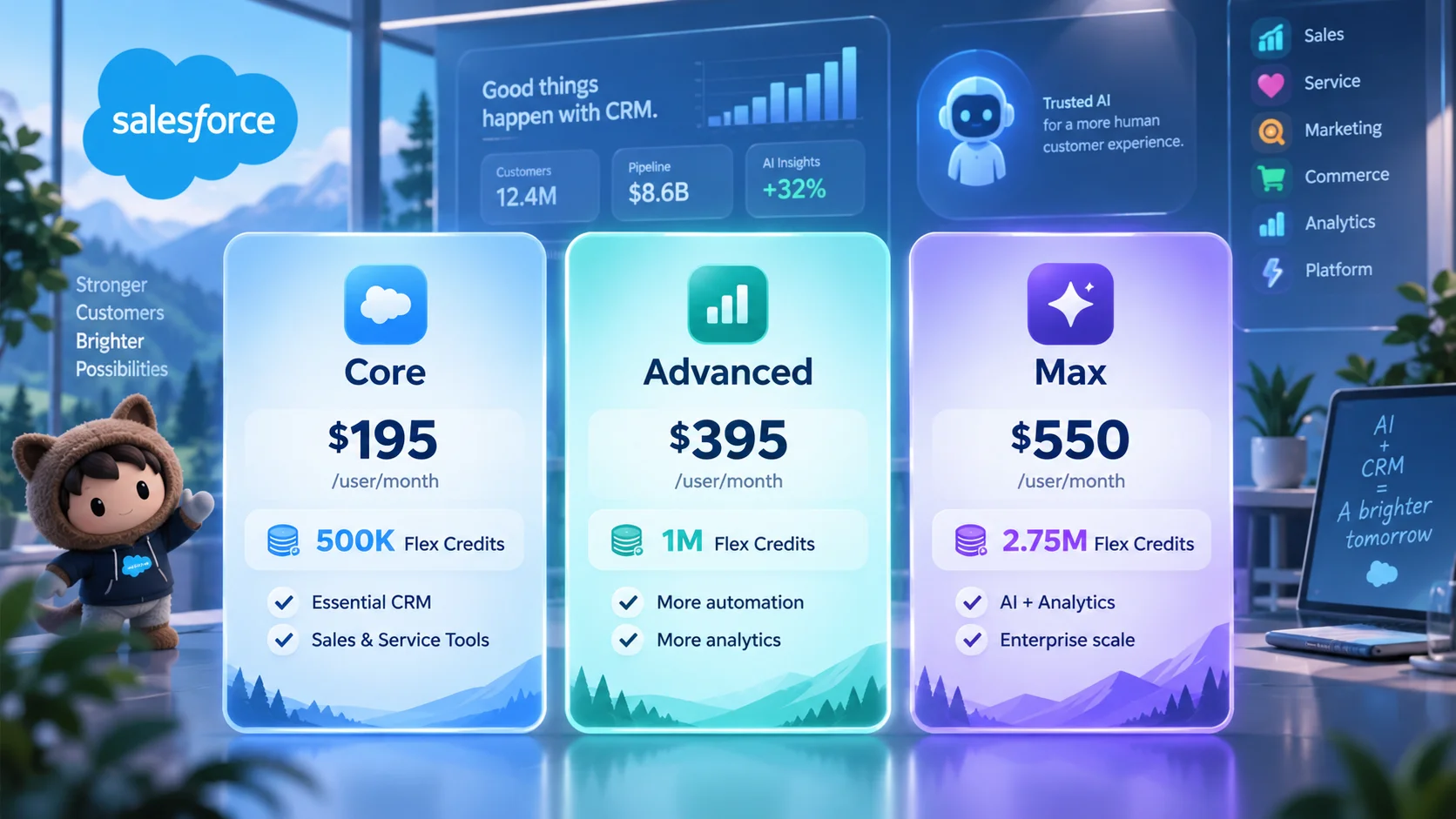
Salesforce Core, Advanced, and Max Pricing
For Sales and Service, Salesforce lists the new pricing structure as follows:
| Edition | Price | Included Flex Credits |
| Core | $195/user/month | 500,000 per org |
| Advanced | $395/user/month | 1 million per org |
| Max | $550/user/month | 2.75 million per org |
Prices are listed in U.S. dollars and billed annually. Salesforce notes that pricing, packaging, and availability can vary by region and customer agreement.
Businesses evaluating the Sales editions can review Salesforce’s current Sales pricing and edition comparison. Organizations focused on customer support can compare the corresponding Service Cloud pricing and features.
The pricing also shows how Salesforce is repositioning its previous high-end editions.
Legacy Enterprise was priced at $175 per user per month, while Core is $195. Legacy Unlimited was $350, compared with $395 for Advanced. At the top, Max remains at $550, matching the previous list price of Agentforce 1.
This change follows an earlier shift in Salesforce’s commercial strategy. SalesforceKing previously covered Salesforce’s pricing increase and expansion of Agentforce licensing, which provides useful background on how Salesforce had already started bundling more AI functionality into its higher-tier offerings.
Salesforce says Core provides approximately 70% more value than the legacy Enterprise package, Advanced provides more than 50% more value than Unlimited, and Max provides nearly 60% more value than Agentforce 1.
These percentages are Salesforce’s own assessment of the additional products and capabilities bundled with the new editions.
What Comes with Salesforce Core?
Core becomes the new entry point into Salesforce’s higher-end CRM environment.
Rather than providing CRM functionality alone and requiring organizations to purchase many additional tools separately, Salesforce is bringing collaboration, agent capabilities, analytics, support, and other functionality closer to the base package.
For Agentforce Sales Core, Salesforce highlights capabilities such as Momentum, Slack Business+, CRM functionality, and built-in agentic capabilities.
Momentum is particularly notable. Salesforce describes it as a way to capture data and keep CRM records updated so sellers and managers have better visibility into their work and pipeline.
For Service organizations, Core includes essential capabilities such as:
- Case Management
- Self-Service Help Center
- Slack Business+ with Slackbot
- Core service automation and CRM functionality
Salesforce includes 500,000 Flex Credits per organization with Core, giving companies an initial pool that can support experimentation and deployment of eligible consumption-based services.
What Does Salesforce Advanced Add?
Advanced is positioned for organizations that require greater automation, security, capacity, and more sophisticated Salesforce functionality.
On the Sales side, Advanced includes Sales Programs, which organizations can use to create structured and repeatable sales plays.
Salesforce also highlights additional security and data protection capabilities across its higher tiers, including offerings such as Backup & Recover and Data Detect.
For Service organizations, Advanced adds Casey, the Help Agent, along with capabilities such as:
- Everything included in Core
- Premier Success Plan
- Full sandbox
- Backup & Recover
- Data Detect
- Additional Agentforce service functionality
Salesforce also says Agentforce Help Agent is included in Advanced and Max Service editions, helping organizations deploy autonomous service experiences across customer channels.
Advanced organizations receive 1 million Flex Credits, double the pool included with Core.
What Makes Salesforce Max Different?
Max is Salesforce’s highest new edition and is aimed at organizations planning much broader adoption of Agentforce and the Salesforce platform.
For Sales, Max combines Salesforce CRM with a larger collection of sales, collaboration, agent, analytics, and planning capabilities.
Salesforce’s current Sales comparison shows Max adding capabilities such as Slack Enterprise+ and broader sales functionality beyond the lower tiers.
For Service, Max is considerably more extensive.
Salesforce lists capabilities that include:
- Everything in Advanced
- Contact Center
- Workforce Engagement Management
- Quality Management
- IT Service
- Service Rep Assistant
- Service agent templates
- Unmetered Coworker access for applicable users
- 2.75 million Flex Credits per organization per year
Organizations considering the top tier should review the detailed Salesforce Service edition comparison because individual entitlements can differ substantially between Core, Advanced, and Max.
There is another important point for existing customers.
Salesforce says organizations currently using Agentforce 1 Edition can upgrade to Max without an additional edition price increase. The company says Max provides up to $500 in additional bundled value compared with Agentforce 1.

What Are Salesforce Flex Credits?
Flex Credits are Salesforce’s consumption unit for Agentforce and an expanding range of usage-based services.
Instead of charging only according to users or conversations, Salesforce can meter specific actions performed by agents.
For example, an agent might retrieve information, update a customer record, automate a workflow, resolve a case, or perform another defined action. Each eligible activity can consume Flex Credits according to Salesforce’s applicable rate card.
According to Salesforce’s official Agentforce pricing documentation:
100,000 Flex Credits cost $500.
Salesforce also states that a standard Agentforce action consumes 20 Flex Credits, equivalent to approximately $0.10 per standard action at the published list rate.
That provides useful context for the credit pools included with the new editions.
If an organization theoretically spent its entire allocation only on standard 20-credit Agentforce actions, the included credits could represent approximately:
- Core: 25,000 standard actions
- Advanced: 50,000 standard actions
- Max: 137,500 standard actions
These figures should not be interpreted as guaranteed usage levels.
Actual consumption depends on what an agent does. Different Salesforce services, actions, prompts, and workloads can have different consumption rates.
Organizations should therefore estimate Agentforce costs around their actual workflows rather than simply dividing their Flex Credit balance by 20.
Credit consumption is also only one part of a successful Agentforce rollout. Production deployments can expose issues involving data quality, escalation rules, business policies, and ongoing monitoring. Our guide to common Agentforce deployment problems and how to fix them explores these practical challenges in more detail.
Flex Credits Are Becoming More Than Agentforce Credits
Another important development is that Salesforce is expanding Flex Credits beyond a narrow Agentforce pricing mechanism.
The company’s Data 360 pricing page states that Flex Credits can be applied to Data 360 actions and can be transferred between Data 360 and Agentforce.
Salesforce currently lists Flex Credits for Data 360 at $500 per 100,000 credits, matching its published Flex Credit pricing model.
This matters because organizations deploying agents generally need more than an intelligent interface. Agents also need access to useful customer, operational, and business data.
A shared consumption model gives companies more flexibility to allocate purchased capacity between eligible Agentforce and Data 360 workloads as requirements change.
Professionals who want to understand the data side of this architecture can also read our Salesforce Data 360 Consultant guide, which covers data integration, identity resolution, data modeling, segmentation, activation, governance, and other core Data 360 concepts.
It also means Salesforce customers increasingly need to think about licensing in two dimensions:
user licenses and consumption.
Tracking Flex Credit Consumption
Consumption-based licensing creates another requirement: visibility.
Organizations need to know which agents, services, and actions are consuming their purchased capacity.
Salesforce provides consumption-management capabilities through Digital Wallet, where customers can review applicable entitlements and usage.
This becomes increasingly important as Salesforce combines conventional per-user subscriptions with consumption-based Agentforce and Data 360 services.
Administrators should monitor usage regularly rather than waiting until the organization approaches its allocated credit limits.
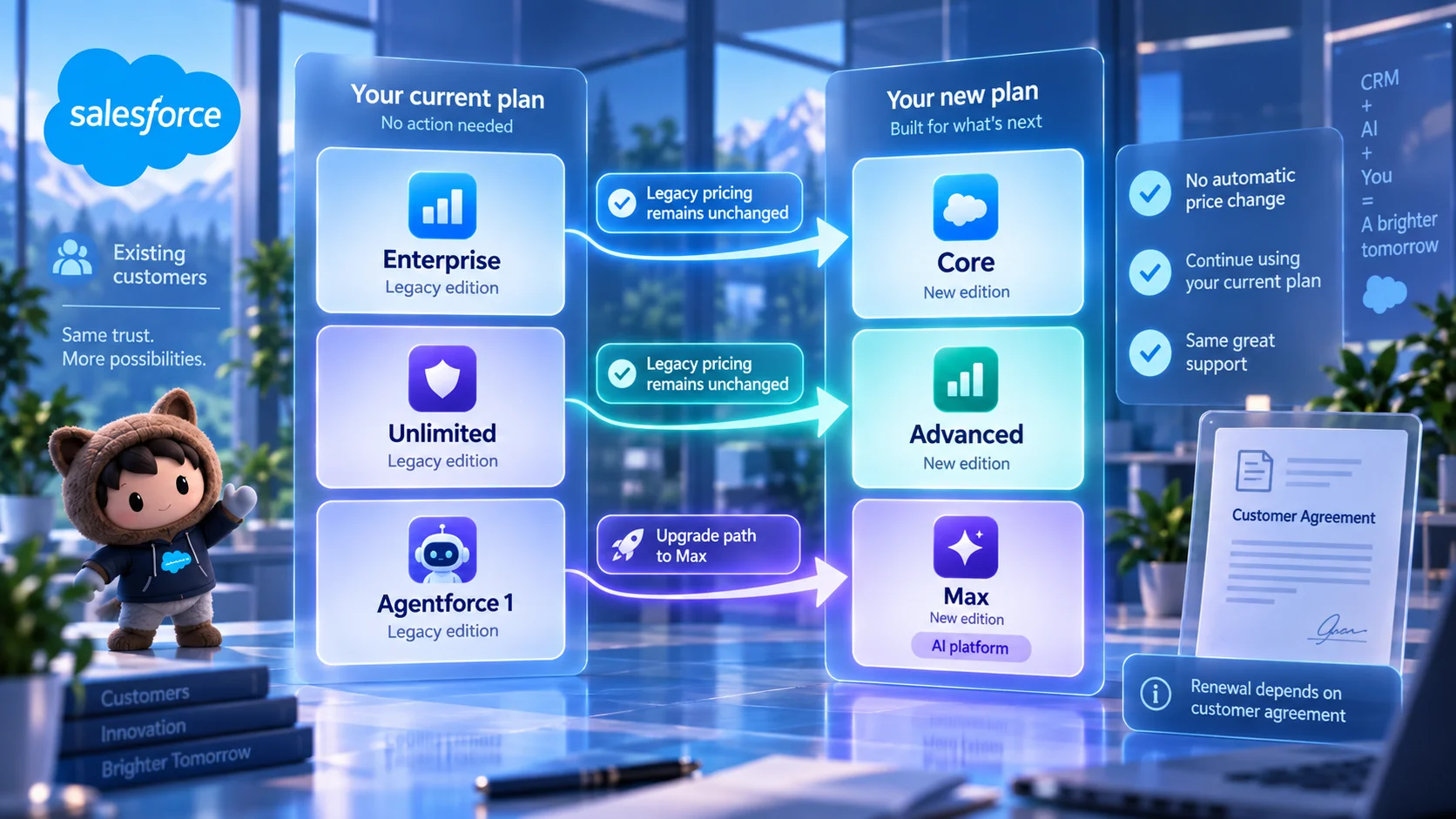
What Happens to Enterprise, Unlimited, and Agentforce 1 Customers?
Current customers should pay close attention to one of the most important statements in Salesforce’s announcement:
Existing customer pricing on legacy editions remains unchanged.
That means the introduction of Core, Advanced, and Max should not be interpreted as an immediate automatic price increase from Enterprise to Core or Unlimited to Advanced for every existing Salesforce customer.
Salesforce is introducing a new packaging and pricing structure while existing legacy-edition pricing continues according to applicable customer agreements.
Agentforce 1 customers are in a particularly interesting position because Salesforce says they can move to Max at no extra edition cost.
Organizations approaching a renewal should still review their contracts carefully. Salesforce pricing can vary according to product mix, negotiated discounts, geography, contract length, consumption commitments, and other commercial terms.
What About Agentforce Industry Editions?
Salesforce is also extending the Core, Advanced, and Max structure to Agentforce Industry Editions.
These offerings combine Sales and Service functionality with industry-specific data models, workflows, governance capabilities, and agent functionality.
Salesforce specifically identifies sectors including:
- Financial services
- Healthcare
- Public sector
- Other specialized industries
Industry editions are designed to provide vertical data structures, preconfigured processes, governance features, and agents designed around industry-specific requirements.
Salesforce says new Agentforce Industry Edition pricing will take effect later in fall 2026.
Exact pricing and availability can vary by region and customer agreement, so organizations should not assume that the standard $195, $395, and $550 Sales and Service prices automatically apply to every Industry package.
Why Salesforce Is Changing Its Edition Strategy?
The larger story behind Core, Advanced, and Max is Salesforce’s gradual shift from selling CRM primarily through user licenses toward a combination of per-user licensing and consumption-based services.
Traditionally, organizations could buy Enterprise or Unlimited and then decide whether they also required separate collaboration, analytics, security, support, data, or AI products.
Core, Advanced, and Max bring more of these capabilities into consolidated packages.
For Salesforce, this makes Agentforce part of the standard platform purchasing conversation rather than something businesses evaluate only after implementing CRM.
For customers, the new structure could reduce the number of separate purchasing decisions. However, businesses still need to understand exactly which functionality is bundled, which features remain optional, and which activities consume additional credits.
Flex Credits are central to this change.
By including a pool of Flex Credits in each new edition, Salesforce gives organizations capacity to experiment with agents without starting from zero consumption entitlement.
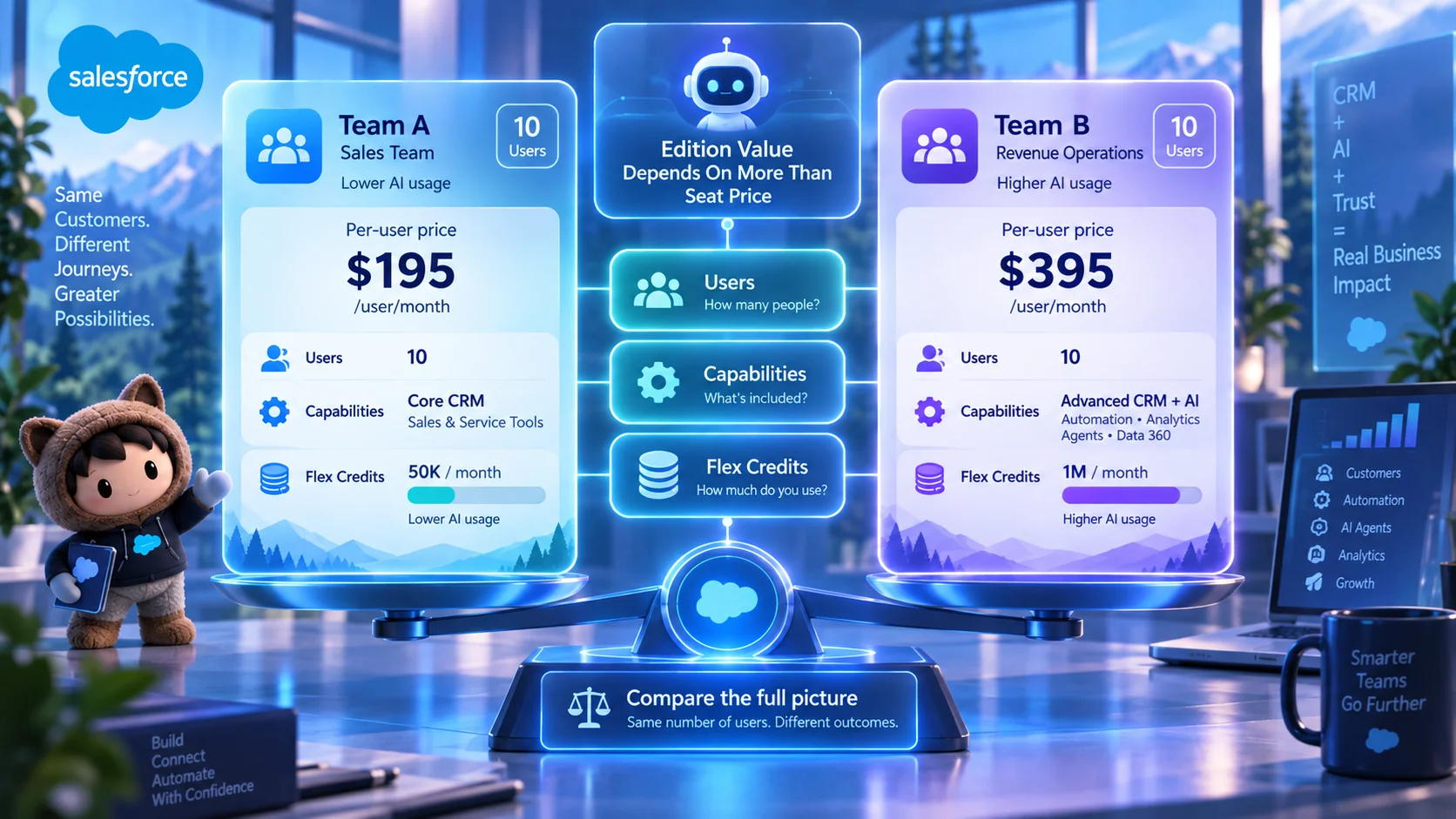
Per-User Price Is No Longer Enough to Compare Editions
One consequence of Salesforce’s new structure is that comparing editions only by price per user becomes less useful.
Organizations increasingly need to evaluate three factors together:
- The number of Salesforce users
- The products and capabilities included with the edition
- Expected Flex Credit consumption
Consider two organizations with the same number of Salesforce users.
One may use Agentforce only for a limited number of internal tasks, while another may deploy customer-facing agents handling thousands of actions every day.
Their user-license costs could be similar while their consumption requirements are very different.
A lower edition can therefore appear less expensive initially but require additional consumption purchases if Agentforce usage grows substantially.
At the same time, Max could provide better overall value for an organization that already needs several of the products and services bundled into the edition.
Businesses should model expected use cases before choosing an edition instead of treating the published per-user price as the complete cost of ownership.
Which Salesforce Edition Makes the Most Sense?
Core is likely to appeal to organizations that need a strong Salesforce CRM foundation while gaining access to newer collaboration and agent capabilities without purchasing the highest tier.
Advanced targets businesses requiring stronger operational capabilities, additional security and data protection, greater platform capacity, and more sophisticated Sales or Service functionality.
Max is designed for organizations planning broad Agentforce adoption and looking for Salesforce’s most extensive package of CRM, collaboration, service or sales functionality.
The included Flex Credit allocation should also influence the decision.
Companies expecting substantial Agentforce usage should estimate the number and types of actions their agents will perform rather than judging an edition only by its monthly per-user price.
Salesforce’s new packaging makes one broader direction clear: Agentforce and consumption-based services are moving closer to the center of the Salesforce platform. For customers, administrators, consultants, and architects, understanding both traditional licensing and Flex Credit consumption will become increasingly important as Core, Advanced, and Max become the foundation of Salesforce’s next generation of CRM packaging.