
Preparing for the Salesforce Certified Marketing Cloud Engagement Consultant exam requires more than reading documentation and memorizing product features. Candidates are expected to understand customer requirements, evaluate different Marketing Cloud capabilities, and select solutions that are practical, scalable, and maintainable.
That makes practice questions a useful part of Marketing Cloud Engagement Consultant exam prep. They can show whether you truly understand a concept, reveal weak areas before exam day, and help you become more comfortable making decisions in scenario-based questions.
Salesforce recommends combining hands-on experience, formal training, Trailhead learning, and self-study when preparing for this credential. The official Marketing Cloud Engagement Consultant exam guide also shows that the certification covers a mixture of technical knowledge, implementation decisions, data architecture, automation, integrations, account configuration, and messaging.
Know the Marketing Cloud Engagement Consultant Exam Before You Start Practicing
Before working through practice questions, understand the current structure of the certification exam.
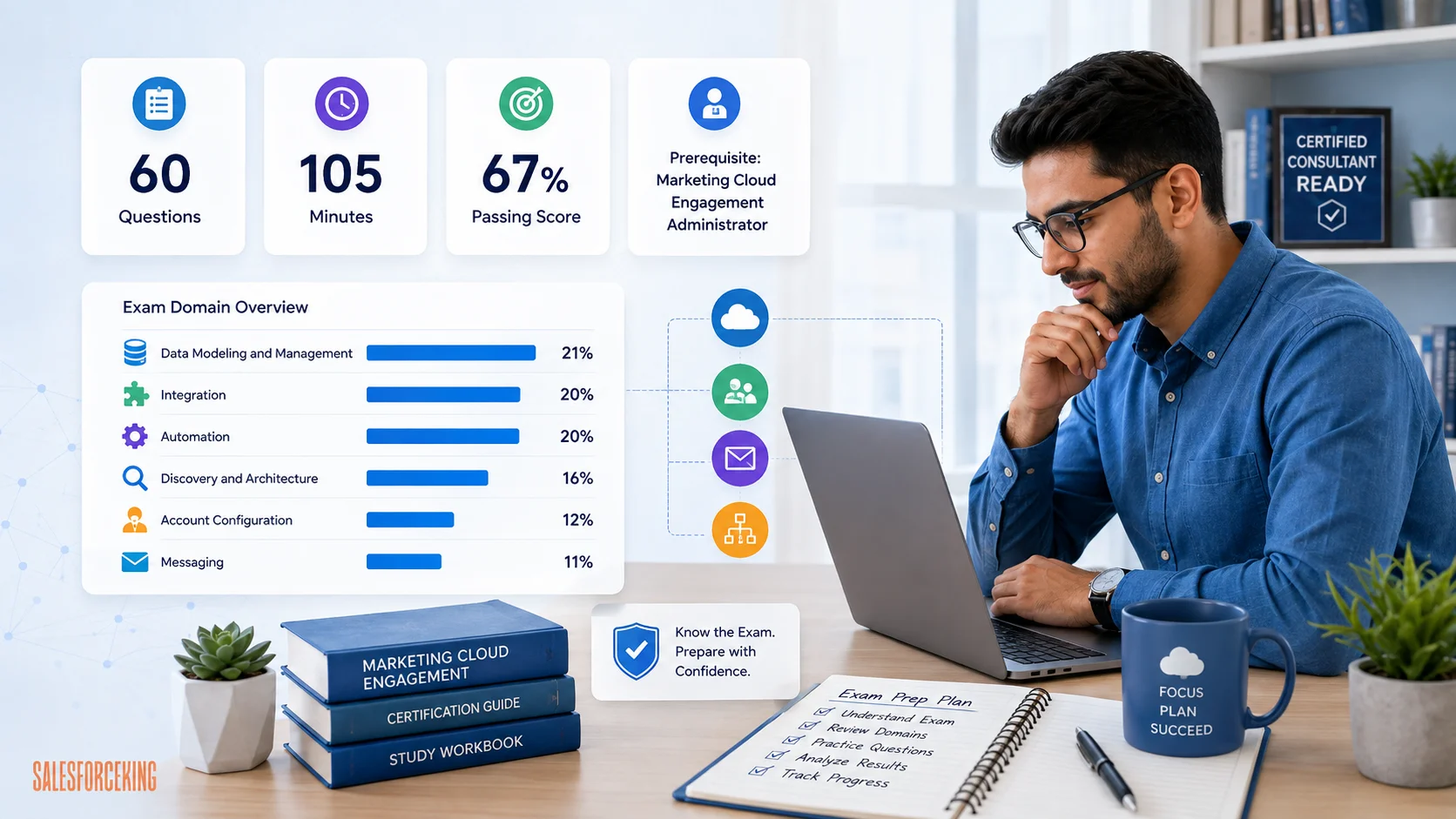
Salesforce lists 60 scored multiple-choice or multiple-select questions, with up to five additional unscored questions. Candidates receive 105 minutes, and the current passing score is 67%. The Salesforce Certified Marketing Cloud Engagement Administrator credential is a prerequisite.
The official domain weights are:
| Exam Domain | Weight |
| Data Modeling and Management | 21% |
| Integration | 20% |
| Automation | 20% |
| Discovery and Architecture | 16% |
| Account Configuration | 12% |
| Messaging | 11% |
The three largest areas account for 61% of the exam, so your practice plan should give them appropriate attention without ignoring the remaining objectives.
If you are still working toward the prerequisite, SalesforceKing also has Marketing Cloud Engagement Administrator exam questions and explanations that can help you assess your knowledge of the Administrator-level material before moving deeper into Consultant preparation.
Why Marketing Cloud Engagement Consultant Practice Questions Can Improve Learning?
Reading Salesforce documentation is essential, but reading alone can sometimes make a topic feel more familiar than it really is.
You may recognize Contact Builder, Journey Builder, Automation Studio, or Marketing Cloud Connect when you see them in documentation. That does not necessarily mean you can identify the right solution when several similar choices appear in an exam scenario.
Practice questions require you to retrieve information from memory.
Learning research describes this as retrieval practice. A review of the research found that retrieving learned information through testing can improve retention and recall compared with simply studying the material again. The research also indicates that testing is especially useful when it is repeated over time and supported by feedback.
You can read more about the research behind this approach in this review of testing and retrieval practice.
For certification preparation, the practical lesson is simple: do not only ask yourself whether a Salesforce concept looks familiar. Test whether you can recall it and apply it without referring to your notes.
Take a Diagnostic Test First
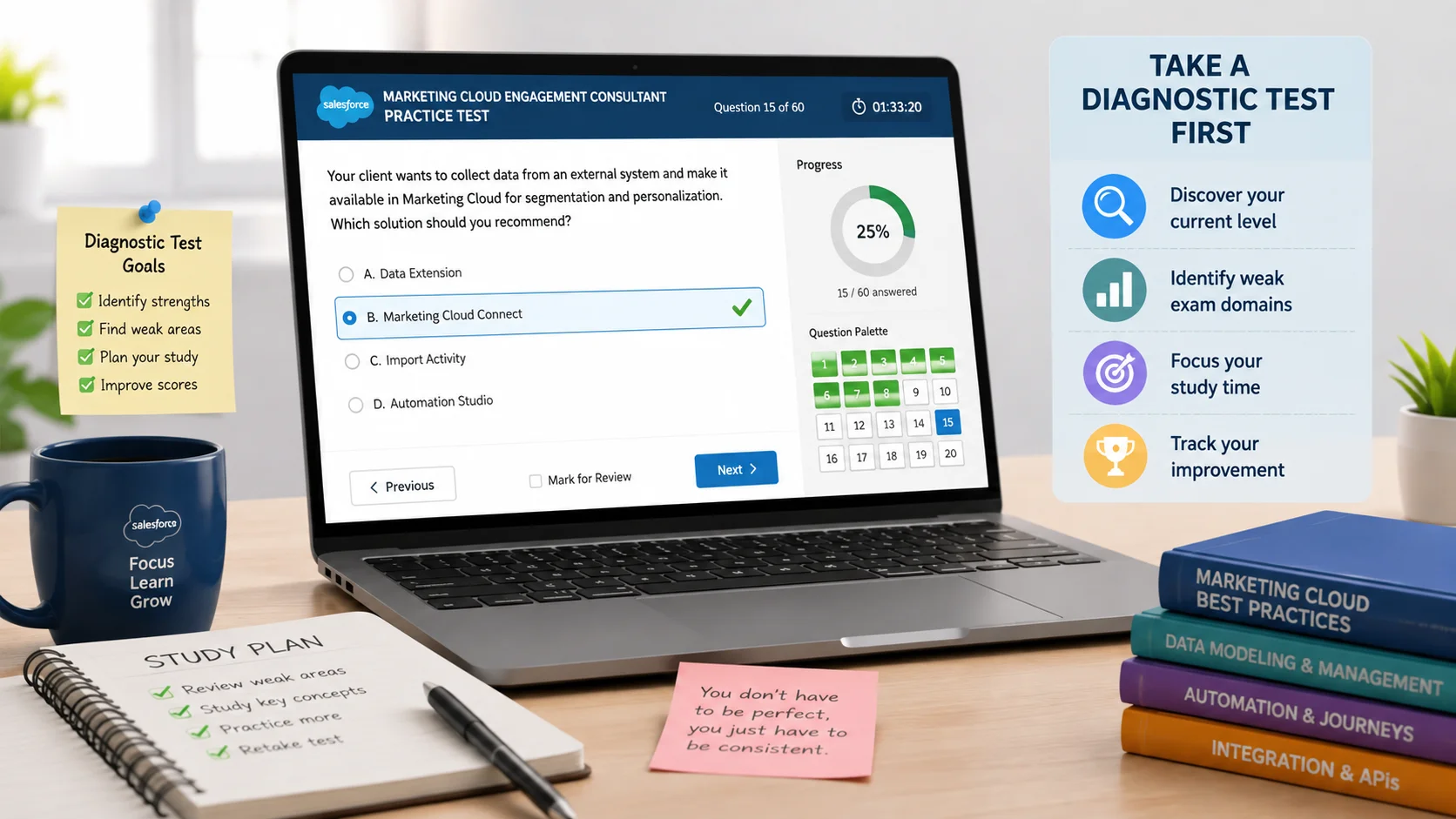
One of the best ways to begin is with a diagnostic test.
Take a set of Marketing Cloud Engagement Consultant practice questions before doing another complete round of study. SalesforceKing Marketing Cloud Engagement Consultant practice test can be used for this type of knowledge check.
The goal of the first attempt should not be to achieve an impressive score. It should be to discover what you already understand and where you need more work.
Answer questions across the different exam domains without checking Salesforce documentation while you work.
You might discover that you are comfortable with Journey Builder but regularly struggle with Marketing Cloud Connect. Another candidate may understand Automation Studio but find customer identity or Data Extension scenarios more difficult.
There is another type of weakness worth watching for. Sometimes you know what two technologies do but cannot decide which one is more appropriate for the customer described in the scenario.
That is an important finding because Consultant-level preparation should develop decision-making skills, not just product recall.
Study Your Weak Domains
Once the diagnostic test identifies your weaker areas, adjust your preparation.
Suppose you answer several Data Modeling and Management questions incorrectly. Instead of reviewing every Marketing Cloud topic again, return to Salesforce’s documentation and learning resources for the concepts behind those mistakes.
Then practice that domain again.
This creates a more focused study cycle:
Test → Identify the gap → Study → Practice again
Your overall practice score can be useful, but domain-level performance often tells you much more.
For example, six incorrect answers may initially look like six unrelated mistakes. If four of them belong to Integration, you have identified an obvious priority for your next study session.
This approach makes preparation more efficient because your time is directed toward areas where additional study can make the biggest difference.
Review Why Your Answer Was Wrong
The explanation that follows a practice question can be more valuable than the score itself.
When you choose the wrong answer, do not simply memorize the correct option and continue.
Ask why your answer was weaker.
Salesforce describes the Marketing Cloud Engagement Consultant as someone capable of creating solutions that satisfy customer requirements and contribute to long-term success. The exam objectives repeatedly use scenario-based wording that asks candidates to determine, evaluate, recommend, or design an appropriate solution.
That means two answers may initially sound reasonable.
One might technically work, while another better addresses the customer’s requirements, existing architecture, maintainability, skills, or future plans.
When reviewing an incorrect question, identify the requirement you missed. Determine which Marketing Cloud capability mattered most and why the selected answer was less suitable.
Also review questions you answered correctly but guessed.
A lucky answer should not be counted as mastered knowledge. If you cannot explain why the correct choice is stronger than the alternatives, the underlying topic deserves another review.
Retake Questions After a Few Days
Immediately repeating a question can produce a misleading result.
You may remember that option C was correct without remembering the Salesforce concept that made it correct.
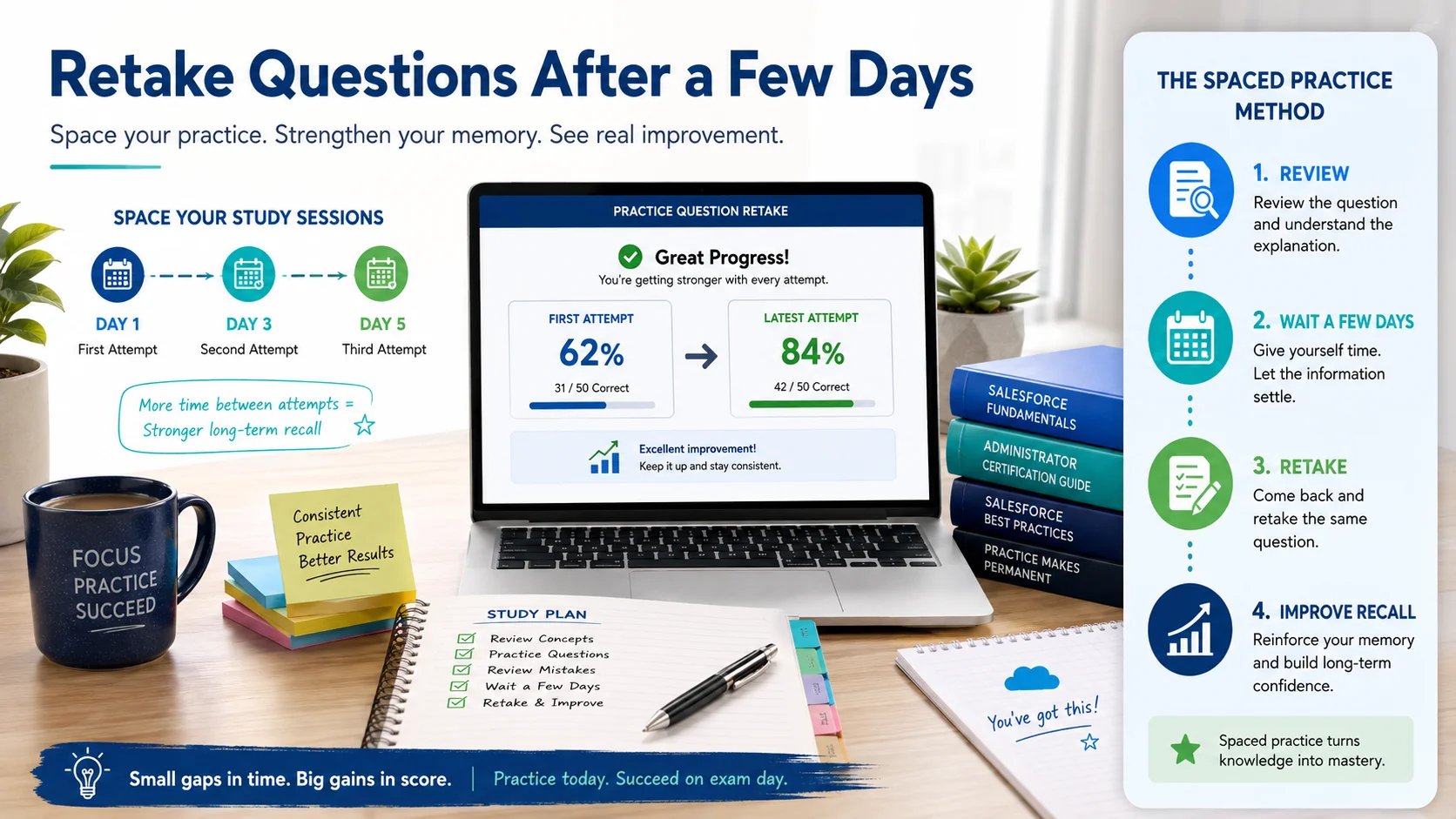
Instead, review the topic and leave some time before attempting the question again.
Research into retrieval-based learning supports practicing retrieval over time rather than relying only on repeated study. Retrieval can slow forgetting and strengthen your ability to access information later.
After a few days, return to the questions you missed or guessed.
Try to answer them without looking at your previous responses. More importantly, explain the reasoning behind your choice.
If you can solve the question because you understand the underlying concept, that is progress. If you only recognize the wording and remember the answer, you need more varied practice.
Build Scenario-Based Thinking
Practice questions are especially valuable when they teach you how to analyze a scenario.
Before looking closely at the answer choices, identify the customer’s actual requirement.
- What is the organization trying to accomplish?
- Is there a data limitation?
- Does the solution need to integrate with Salesforce CRM?
- Is maintainability important?
- Does the company require automation, personalization, segmentation, or a particular messaging channel?
Then evaluate each answer against those requirements.
Do not choose an option simply because it describes a valid Marketing Cloud feature.
The better answer is the one that best satisfies the complete scenario.
This habit becomes increasingly important as your knowledge grows because more answer choices will start to look technically possible.
Make Practice Questions Part of a Complete Study Plan
Practice questions should complement official Salesforce resources, not replace them.
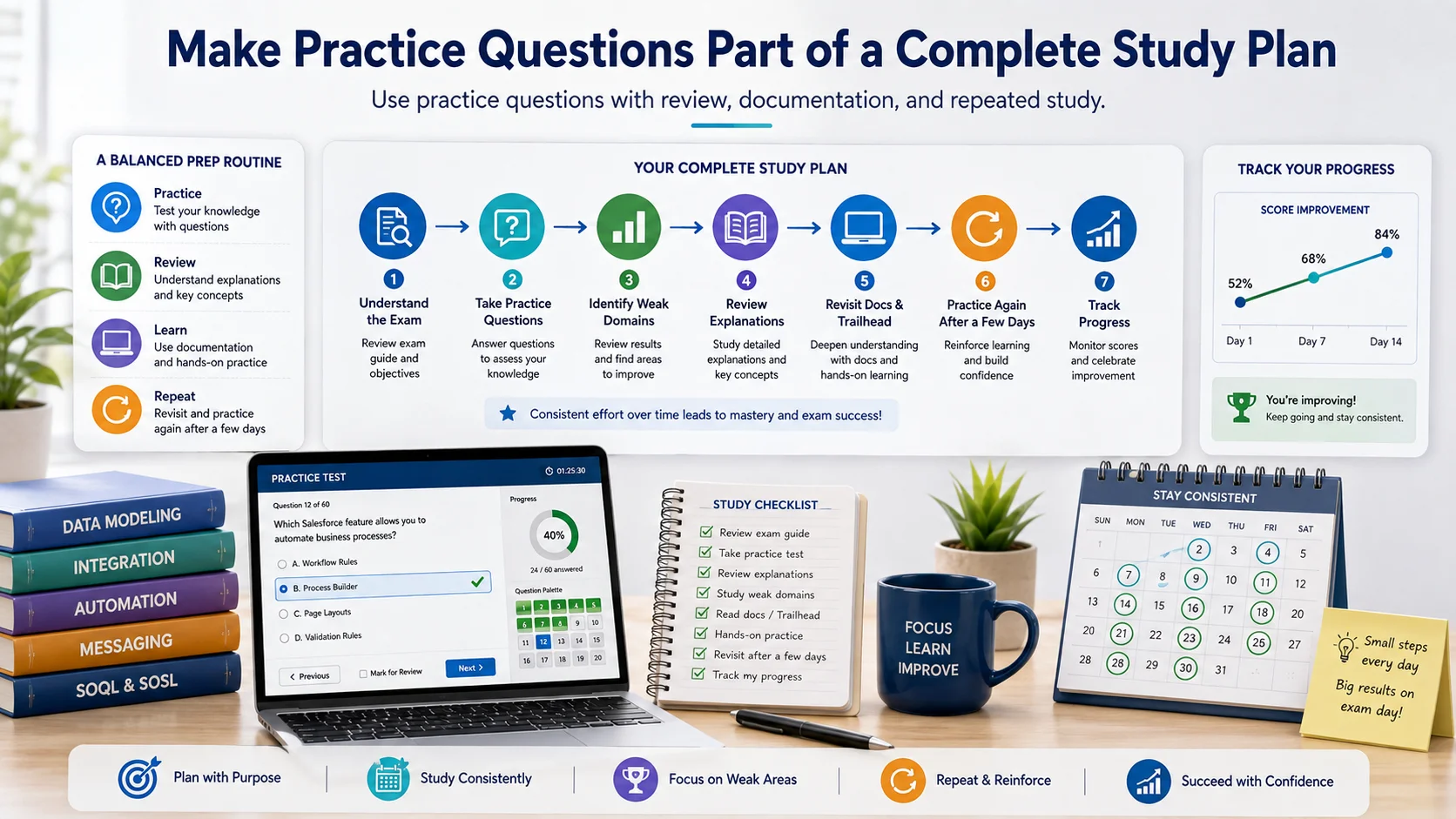
Start with a diagnostic test. Identify your weak domains. Review those subjects using the official exam guide, Trailhead, Salesforce Help, and hands-on experience. Study the explanation behind every incorrect or uncertain response. Then return to those concepts several days later and test yourself again.
Over time, practice scores should become more than percentages.
They should tell you whether you can recognize customer requirements, recall the relevant Marketing Cloud capabilities, eliminate weaker alternatives, and defend your final recommendation.
That is where practice questions provide the greatest value for Marketing Cloud Engagement Consultant exam prep. They turn passive study into an active process and help you measure whether your understanding is actually improving before you sit for the certification exam.
Sources and Further Reading
Salesforce: Salesforce Certified Marketing Cloud Engagement Consultant Exam Guide. Use this as the primary source for the current exam structure, prerequisite, passing score, domain weights, candidate profile, and official objectives.
Research: Testing Enhances Learning: A Review of the Literature. This review discusses retrieval practice, repeated testing, feedback, and long-term retention.
Research:Practicing Retrieval Facilitates Learning. This review examines how retrieval practice can improve later access to learned information.