
You’ve studied hard, reviewed your notes, and feel confident about Apex, triggers, and governor limits. Then exam day arrives. The clock starts ticking, you hit a confusing scenario-based question in the first ten minutes, and your focus temporarily falters. Sound familiar?
This is one of the most common experiences candidates face with the Salesforce Platform Developer Exam. The challenge isn’t always knowing the material. Often, it’s knowing how to work through the exam itself under pressure. Time slips away faster than expected, tricky questions create doubt, and mental fatigue sets in before you reach the final section.
That’s why strategy matters just as much as content knowledge. Having a smart, repeatable approach to how you move through the exam can be the difference between passing on your first attempt or scheduling a retake. Here are five practical strategies to help you do exactly that.
1. Set a Personal Time Budget Before You Start
The exam gives you 105 minutes to answer 60 questions, roughly 1 minute and 45 seconds per question. That feels generous until you’re staring at a complex code snippet trying to trace execution order. Also worth noting: the exam may include up to five unscored questions, so focus on steady progress rather than exact counts.

Before diving in, mentally divide the exam into thirds using this simple pacing guide:
| Exam Section | Questions | Target Time | Purpose |
| First Third | Questions 1-20 | ~30 minutes | Build momentum, bank easy marks |
| Second Third | Questions 21-40 | ~30 minutes | Maintain pace, flag tricky ones |
| Final Third + Review | Questions 41-60 | ~45 minutes | Complete, revisit flagged items |
Set quick mental checkpoints at question 20 and question 40. A glance at the clock keeps you on track without disrupting your momentum.
Quick tips to protect your time budget:
- Never spend more than 2 minutes on a single question without flagging it
- Avoid rereading the same question more than twice if you’re stuck
- Save the last 10–12 minutes strictly for reviewing flagged questions
2. Read Each Question Twice Before Looking At Answers
This sounds obvious, but most people skip it under pressure. The first read gives you the general idea. The second read is where you catch the details that determine the correct answer.

Pay close attention to qualifying words. These small words completely change what the question is asking:
| Watch Out For | Why It Matters |
| Always / Never | Absolute statements are rarely correct in edge-case scenarios |
| Best practice | Points to the most efficient or recommended approach, not just any valid one |
| Most appropriate | Asks for judgment, not just technical correctness |
| Possible | Accepts any technically valid answer, even a poor one |
Consider this example:
- “Which approach is possible when handling DML inside a loop?” — accepts any technically valid answer
- “Which approach represents best practice when handling DML inside a loop?” — specifically targets efficient, governor-limit-conscious design
Both questions look similar, but missing that one-word costs you the mark.
3. Use Elimination to Narrow Your Options
When you’re unsure, don’t guess blindly. Work backwards by removing answers that are clearly wrong first.
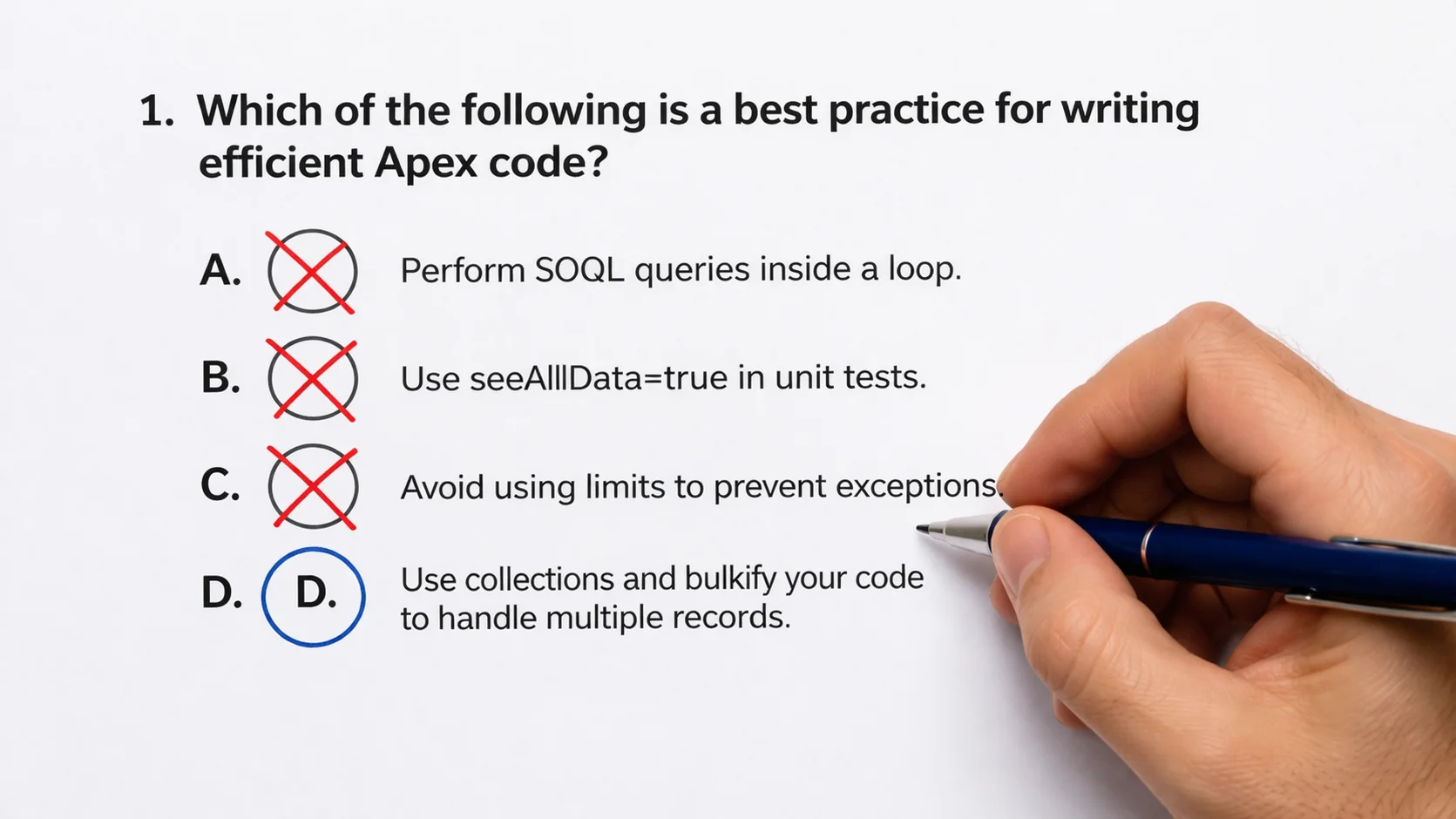
How to eliminate effectively:
- Remove syntax errors first: If an answer contains incorrect Apex syntax or references a method that doesn’t exist, cut it immediately
- Spot concept mismatches: If an answer introduces a concept unrelated to the scenario (like using a Flow when the question is clearly about Apex), eliminate it
- Flag governor limit violations: Any option that involves DML or SOQL inside a loop is almost never the right answer in a best-practice question
- Watch for absolute language: Answers using “always” or “never” in options are often distractors
Most Salesforce Platform Developer Exam Questions include at least one or two options you can eliminate quickly. Once you’ve narrowed it down to two choices, look for the answer that’s more specific to the given scenario rather than just generally correct. The exam rewards contextual thinking, not just recall.
4. Approach Scenario-Based Questions Like a Developer
Scenario questions test real-world judgment. They describe a business requirement and ask for the best technical solution, often including details that are intentionally irrelevant to test your focus.
Treat it like a sprint planning discussion. Identify what the requirement is asking, then flag any technical constraints mentioned in the scenario.
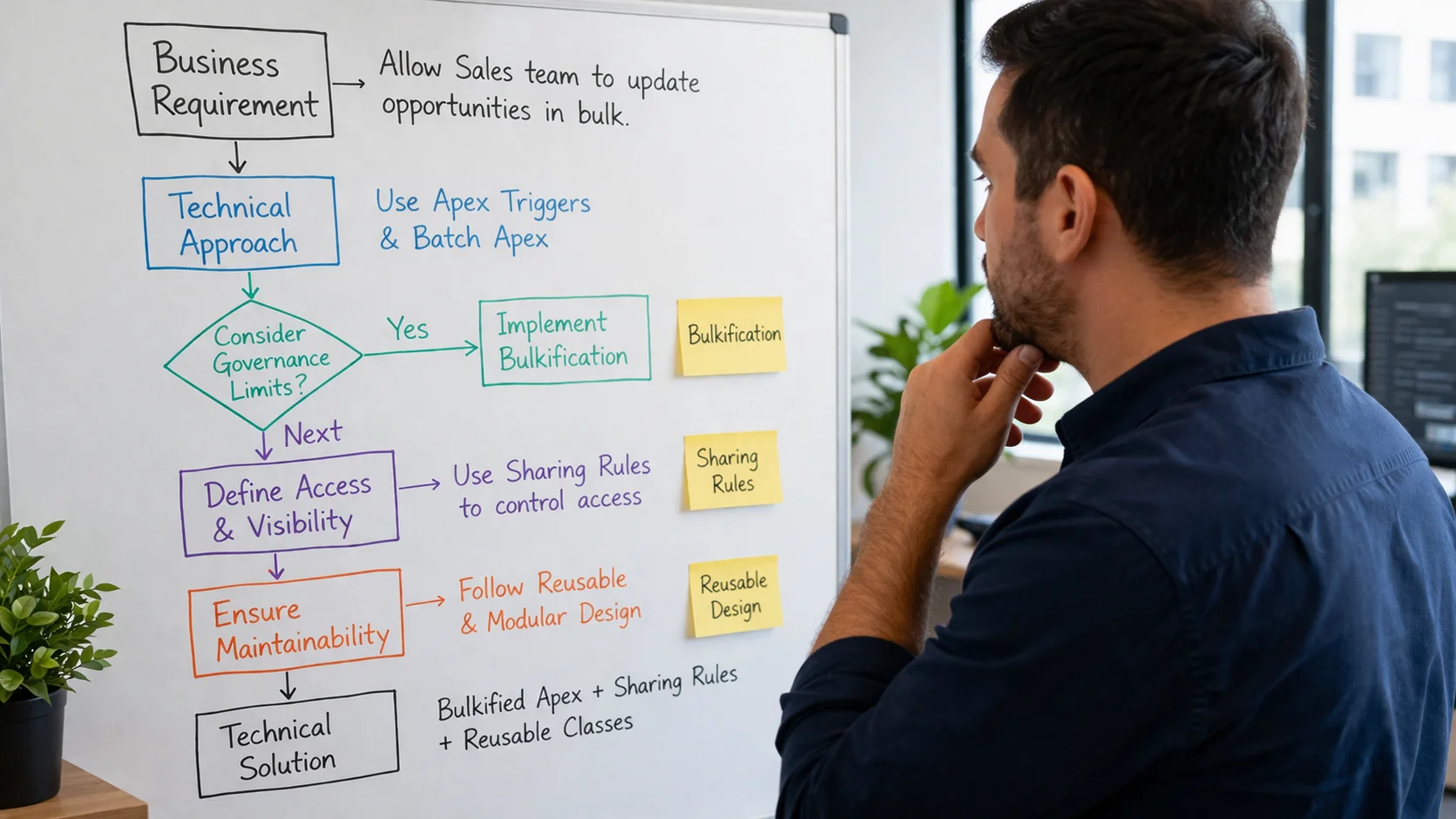
Here are three constraint types that appear frequently and what they signal:
| Constraint Type | Signal Phrase to Watch For | What It Points To |
| Bulkification | Must handle large data volumes / runs in batch | Collection-based logic, no DML/SOQL in loops |
| Sharing and Security | Respect user permissions / record visibility | with sharing or without sharing class design |
| Reusability | Across multiple objects / scalable solution | Interface-based design or a generic handler pattern |
A simple 3-step approach for scenario questions:
- Read the business requirement and ignore irrelevant background details
- Identify the constraint keyword from the table above
- Match the constraint to a technical approach before reading the answer options
Spotting these constraints early steers you toward the right answer category before you’ve even read the options.
5. Flag and Move On, Then Return with Fresh Eyes
Getting stuck drains both time and confidence. If you’ve spent more than two minutes on a question and still feel uncertain, flag it and keep moving.
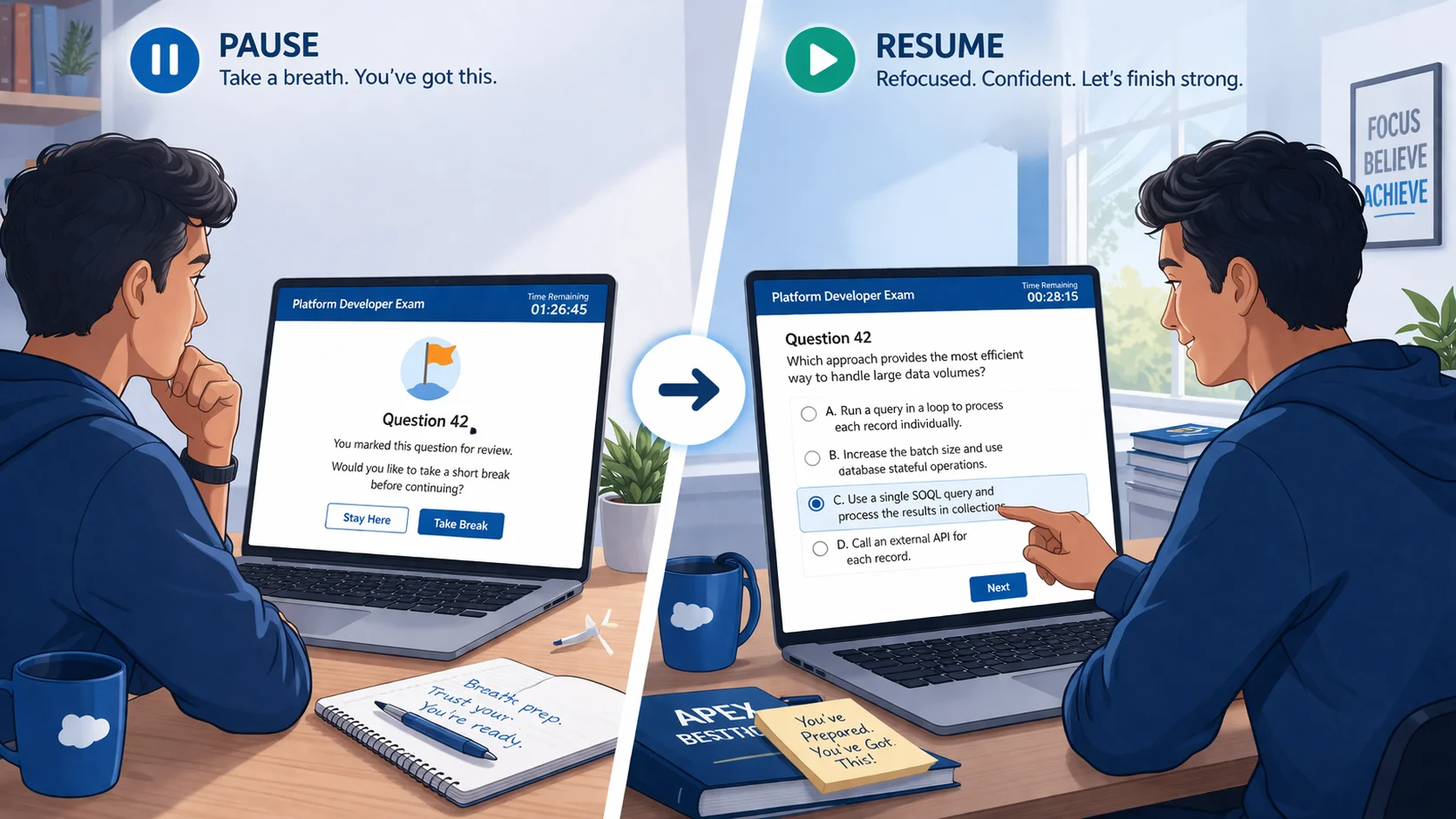
This approach represents effective time management rather than concession. Here’s why it works:
| Benefit | Explanation |
| Protects your score | You earn marks on questions you know while preserving time for harder ones |
| Reduces anxiety | Moving forward maintains momentum and keeps confidence steady |
| Improves perspective | Returning later often reveals details you missed the first time |
| Hidden hints | A later question occasionally contains logic that helps you answer an earlier flagged one |
How to use the flag strategy effectively:
- Flag any question where you’ve spent over 90 seconds without a clear answer
- Never leave a question completely blank — make your best guess before flagging so you have a fallback if time runs out
- During your review pass, prioritize flagged questions where you’ve already eliminated at least one option
- If you’re still unsure after two passes, go with your gut — first instincts are often right
During preparation, practicing this rhythm through timed mock exams using platforms like SalesforceKing helps make the habit feel second nature before test day arrives.
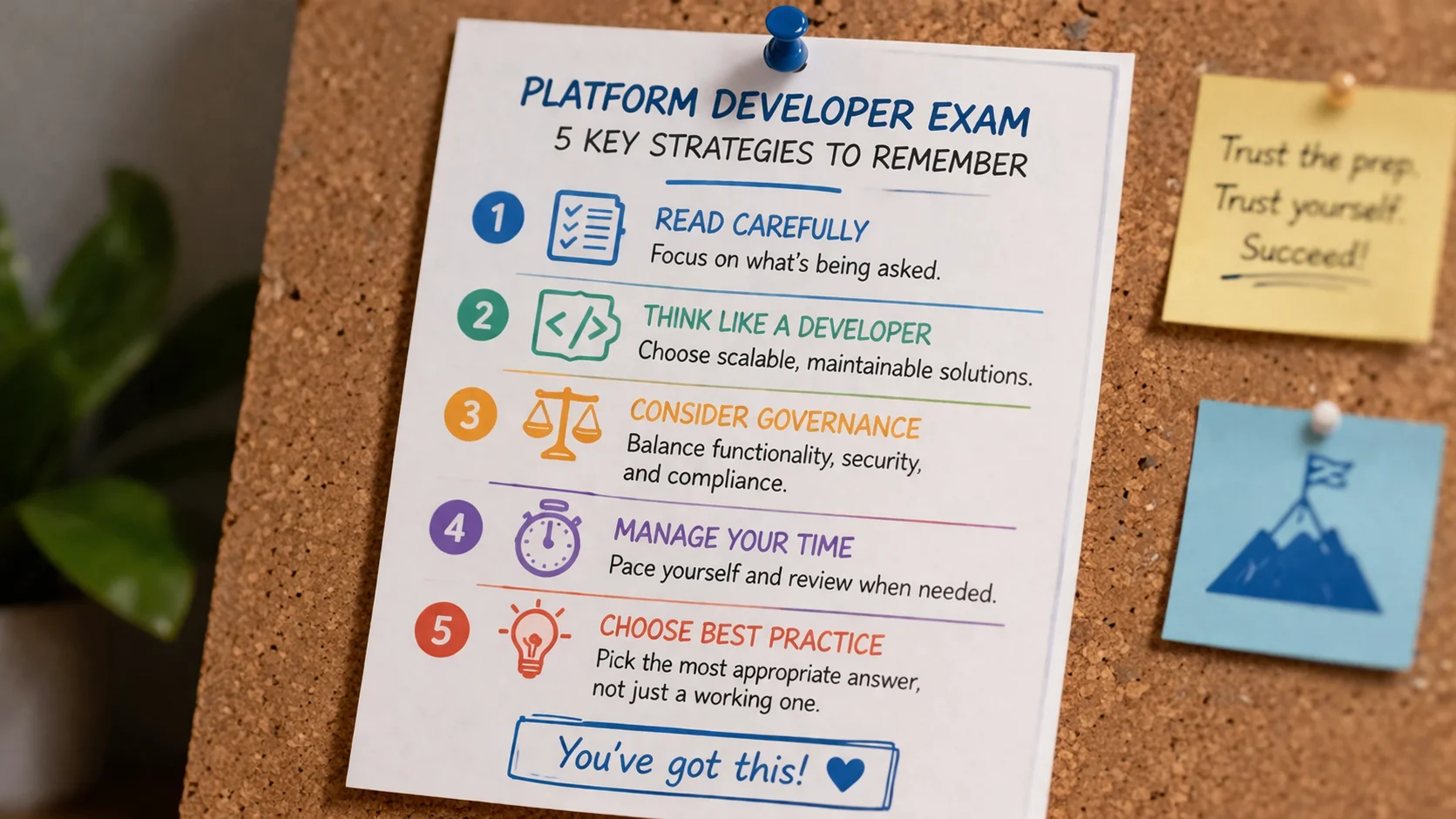
Quick Reference: All 5 Strategies immediately
| Strategy | Core Principle | Key Action |
| Time Budget | Divide exam into thirds | Checkpoint at Q20 and Q40 |
| Read Twice | Catch qualifying words | Spot “best practice” vs “possible” |
| Eliminate First | Narrow options logically | Remove syntax errors and mismatches |
| Scenario Thinking | Identify constraints early | Map constraints to technical patterns |
| Flag and return | Protect time and confidence | Guess, flag, revisit later |
By applying these five strategies, you can prevent that early moment of panic from derailing your performance and reach the final questions with composure and clarity. Knowledge gets you into the exam room. Strategy is what carries you through it. You’ve done the preparation work. Now trust your approach and execute.
Also Read:
Comparing Salesforce Admin vs. Developer Certification Paths
How to Transition from Admin to Developer: A Salesforce Career Path Guide