Last Updated On : 29-Jun-2026
Salesforce Certified Platform Developer - Plat-Dev-201 Practice Test
Prepare with our free Salesforce Certified Platform Developer - Plat-Dev-201 sample questions and pass with confidence. Our Salesforce-Platform-Developer practice test is designed to help you succeed on exam day.
Salesforce 2026
The following code snippet is executed by a Lightning web component in an environment with more than 2,000 lead records: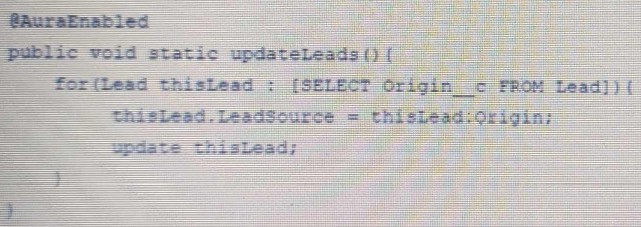
Which governor limit will likely be exceeded within the Apex transaction?
A. Total number of DML statement issued
B. Total number of SOQL queries issued
C. Total number of records retrieved by SOQL queries
D. Total number of records processed as a result of DML statements
Explanation:
Salesforce imposes strict governor limits to ensure efficient resource usage. In an environment with more than 2,000 lead records, an Apex transaction is likely to exceed the total number of records retrieved by SOQL queries, which is capped at 50,000 records per transaction.
Why Option C is Correct?
✅ SOQL queries in bulk transactions retrieve large data sets, potentially surpassing the record retrieval limit.
✅ If the query is not optimized, it might fetch more than the allowed number of records, triggering a limit error.
✅ Using pagination techniques or selective filters can help manage the retrieved record count efficiently.
A developer created this Apex trigger that calls MyClass,myStartmethod:
The developer creates a test method that calls MyClase,myStartmethod directly, resulting in 81% overall code coverage.
What happens wtier the developer tries to deploy the ... and two classes to production, assuming no other code exists?
A. The deployment fails because the Apr- MgQM has no code coverage.
B. The deployment tails because no assertions mett made in the lest method.
C. The deployment passes became the Apex code has the requited 75% code coverage.
D. The deployment passes because both classes and the trigger were included ki the deployment.
Explanation:
Even though the test method directly calls MyClass.myStartMethod() and achieves 81% overall code coverage, the Apex trigger itself has no explicit coverage, meaning the deployment will fail.
Key Considerations for Deployment:
✅ Salesforce requires at least 75% code coverage for Apex classes and triggers.
✅ Triggers must have their own coverage—calling a method indirectly does not cover the trigger execution.
✅ Test methods must explicitly invoke the trigger logic to count toward the trigger's coverage.
| Salesforce-Platform-Developer Exam Questions - Home | Previous |
| Page 6 out of 48 Pages |