
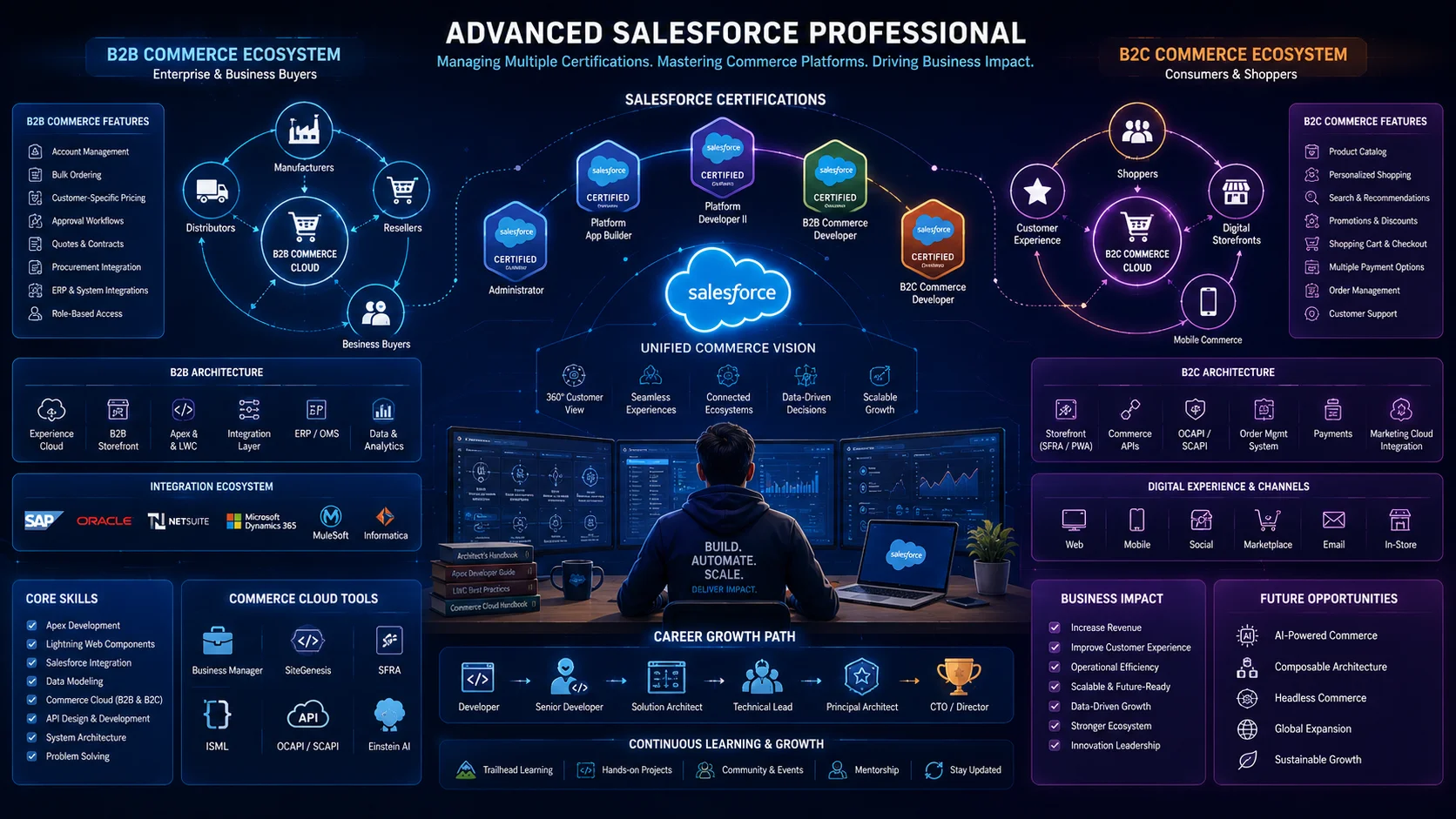
Choosing between the B2B Commerce Developer Exam and the B2C Commerce Developer Exam is not simply a certification decision – it is a career specialization decision.
Many Salesforce professionals assume both certifications cover similar technologies because they fall under the Salesforce Commerce umbrella. They prepare developers for entirely different business environments, technical architectures, and long-term career paths.
One certification focuses on helping businesses buy from other businesses through account-based purchasing, negotiated pricing, and complex procurement workflows. The other focuses on helping brands sell to consumers through high-performance digital storefronts, personalized shopping experiences, and retail-focused commerce strategies.
If your goal is to invest your time wisely and choose the certification that best aligns with your skills and career ambitions, understanding these differences is critical. This guide provides a practical, experience-focused comparison to help you determine which certification delivers the greatest value for your specific situation.
Understanding the Fundamental Difference
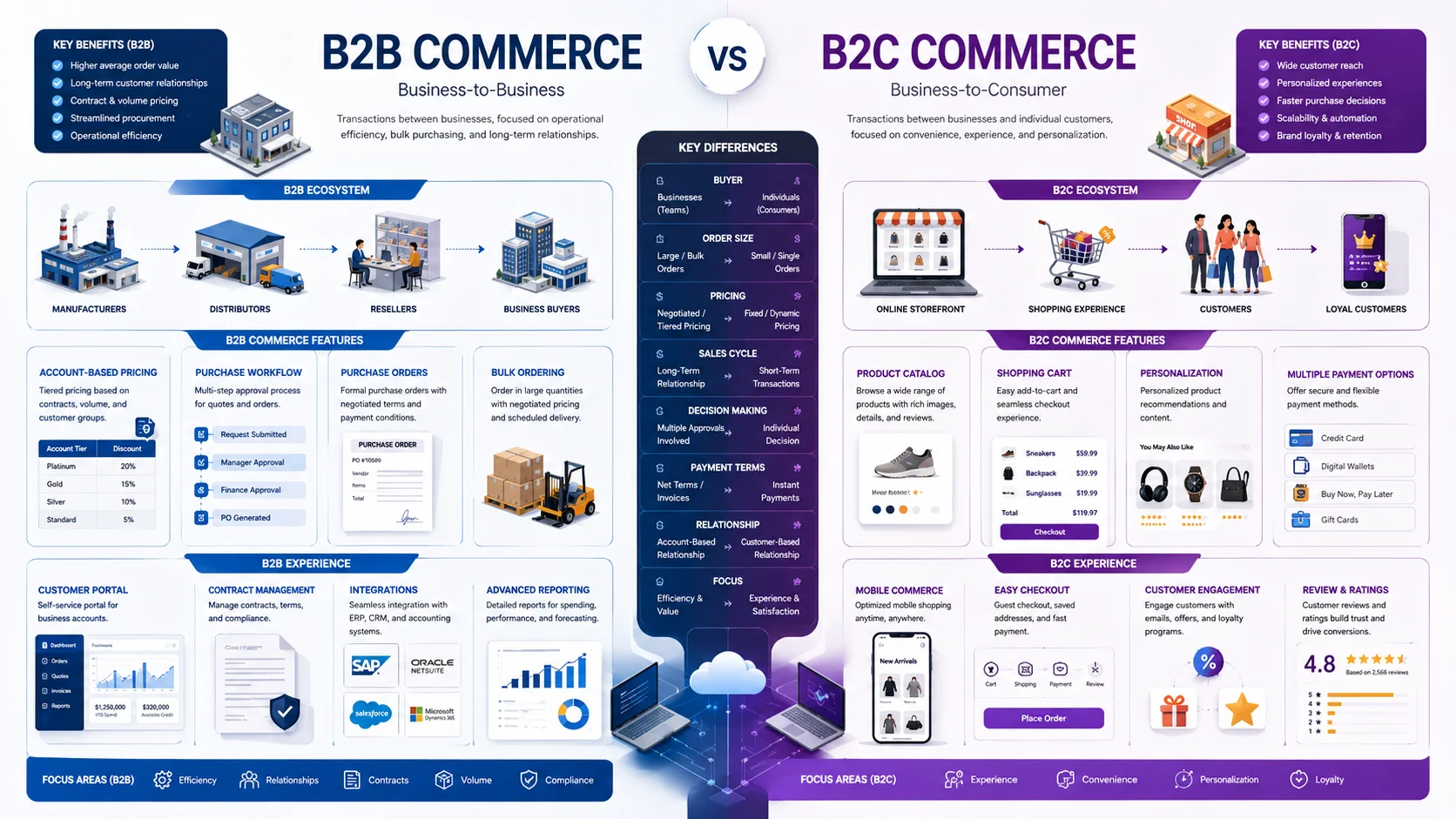
Before comparing the certifications, it is important to understand the business models they support.
B2B Commerce
Business-to-Business (B2B) Commerce enables transactions between organizations.
Examples include:
- Manufacturers selling to distributors
- Wholesalers selling to retailers
- Suppliers selling to enterprise customers
- Procurement portals for large organizations
These environments often involve:
- Negotiated pricing
- Contract-based purchasing
- Account hierarchies
- Approval workflows
- Large-volume orders
- ERP integrations
B2C Commerce
Business-to-Consumer (B2C) Commerce enables companies to sell directly to customers.
Examples include:
- Fashion retailers
- Electronics stores
- Luxury brands
- Consumer goods companies
- Direct-to-consumer businesses
These environments prioritize:
- Customer experience
- Personalization
- Promotions and discounts
- Search optimization
- Storefront performance
- Conversion rates
Because the business objectives differ significantly, the developer skill sets and certification requirements also differ.
B2B Commerce Developer vs. B2C Commerce Developer: Quick Comparison
| Feature | B2B Commerce Developer | B2C Commerce Developer |
| Target Audience | Businesses | Consumers |
| Platform | Salesforce B2B Commerce | Salesforce Commerce Cloud |
| Development Focus | Enterprise purchasing workflows | Digital storefront experiences |
| Primary Technologies | Apex, LWC, Flows, APIs | JavaScript, SFRA, ISML |
| Typical Customers | Manufacturers, wholesalers, distributors | Retailers and consumer brands |
| Order Complexity | High | Moderate |
| Transaction Volume | Lower volume, higher value | High volume, lower value |
| Career Direction | Salesforce ecosystem specialist | Commerce Cloud specialist |
What Projects Will You Actually Build?
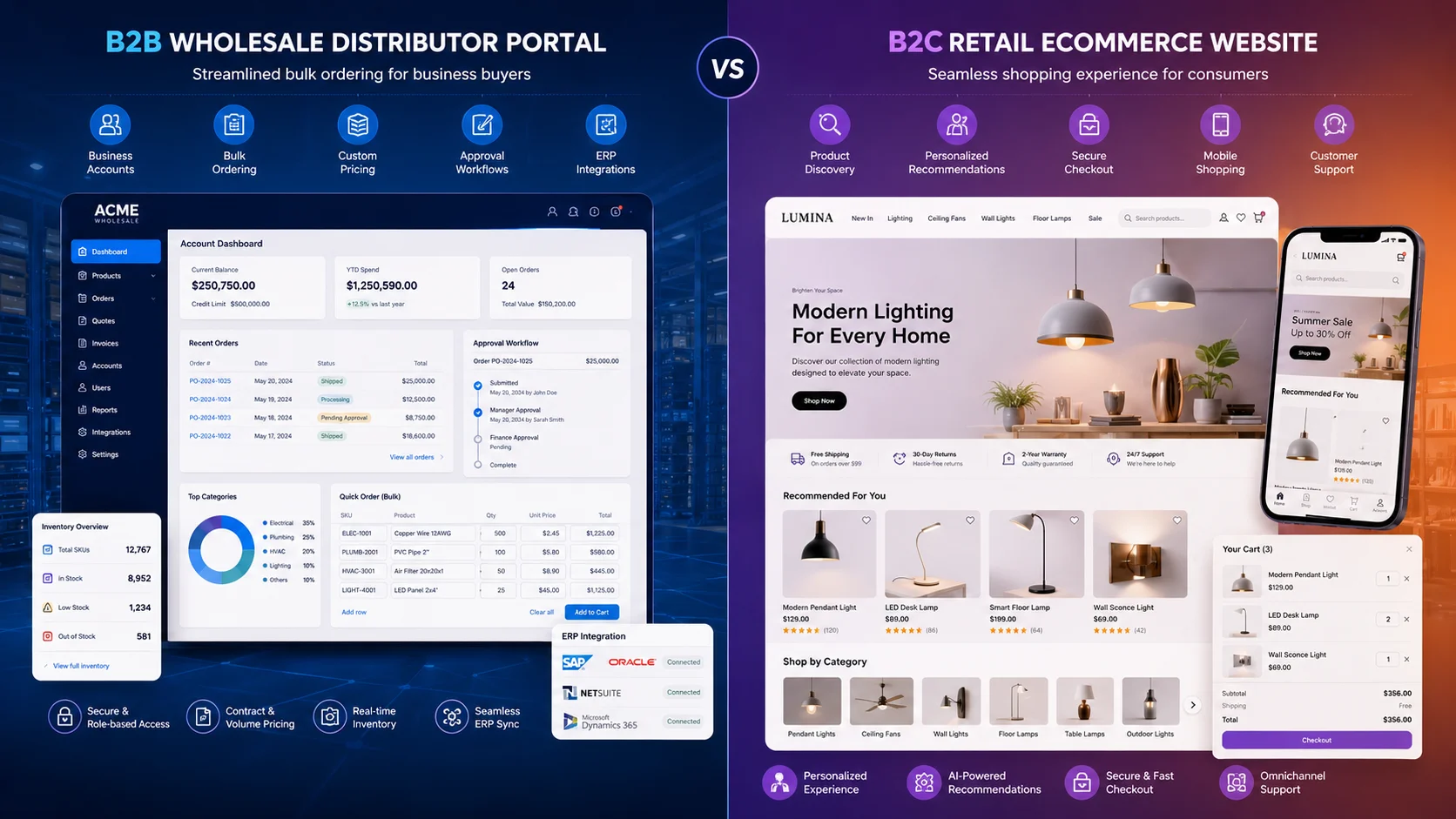
This is often the most overlooked factor when choosing a certification.
Most candidates focus on exam objectives when they should focus on the projects they will be working on for years after certification.
| Project Type | B2B Commerce Developer | B2C Commerce Developer |
| Distributor Portal | ✓ | ✗ |
| Procurement System | ✓ | ✗ |
| Wholesale Ordering Platform | ✓ | ✗ |
| Manufacturer Self-Service Portal | ✓ | ✗ |
| Retail Website | ✗ | ✓ |
| Fashion Storefront | ✗ | ✓ |
| Electronics eCommerce Store | ✗ | ✓ |
| Consumer Shopping Experience | ✗ | ✓ |
A useful rule:
If your customers are businesses, B2B Commerce is likely the better fit.
If your customers are shoppers, B2C Commerce is usually the right choice.
What the B2B Commerce Developer Exam Covers?
The B2B Commerce Developer Exam focuses on implementing and customizing Salesforce B2B Commerce solutions within the broader Salesforce ecosystem.
Key areas include:
- Salesforce data architecture
- Apex development
- Lightning Web Components
- Checkout customization
- Buyer groups
- Catalog management
- Pricing strategies
- Integrations with ERP systems
- Order management workflows
A significant advantage of B2B Commerce is its close connection to Salesforce Core.
Developers frequently work alongside Sales Cloud, Service Cloud, Experience Cloud, and enterprise integrations, making this certification particularly attractive to professionals already working in Salesforce environments.
What the B2C Commerce Developer Exam Covers?
The B2C Commerce Developer Exam focuses on building and extending consumer-facing digital storefronts.
Key areas include:
- Storefront Reference Architecture (SFRA)
- Controllers and middleware
- ISML templates
- Commerce APIs
- Product catalogs
- Promotions
- Search and merchandising
- Site performance optimization
- Business Manager configuration
Unlike B2B Commerce, B2C Commerce development is highly specialized.
Many Salesforce developers are surprised to discover that B2C Commerce development feels much closer to traditional web application development than Salesforce platform development.
Skills Comparison: Which Background Gives You an Advantage?
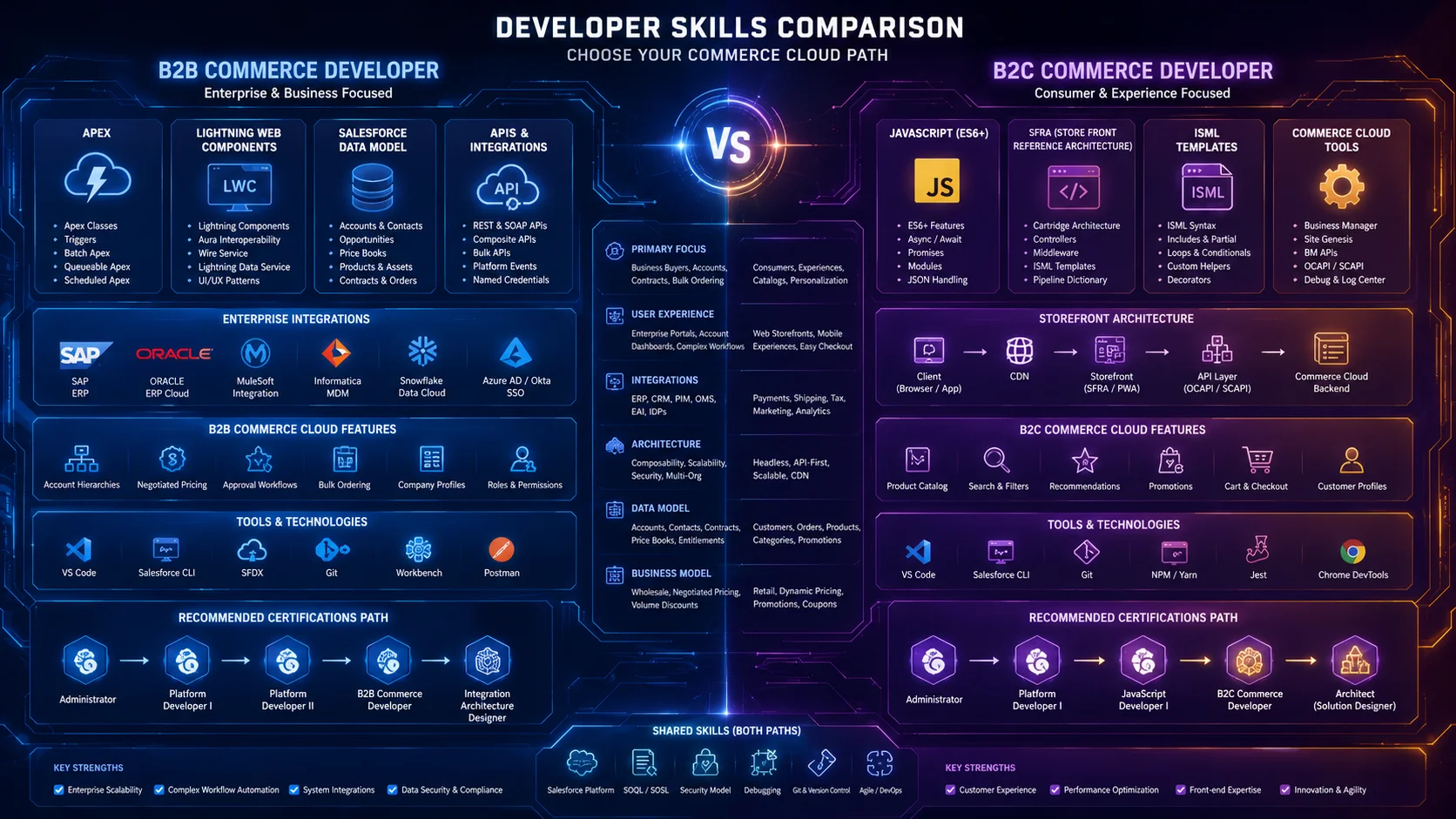
| Skill Area | B2B Commerce Developer Exam | B2C Commerce Developer Exam |
| Apex | High Importance | Low Importance |
| Lightning Web Components | High Importance | Low Importance |
| Salesforce Data Model | High Importance | Low Importance |
| Flow Automation | High Importance | Minimal Importance |
| JavaScript | Moderate Importance | High Importance |
| SFRA Architecture | Not Required | Essential |
| ISML Templates | Not Required | Essential |
| Business Manager | Moderate Importance | High Importance |
| Storefront Development | Moderate Importance | High Importance |
| Enterprise Integrations | High Importance | Moderate Importance |
The certification that feels easier is usually the one that aligns with your current technical background.
Which Certification is Easier?
This is one of the most common questions candidates ask.
The honest answer is that neither certification is objectively easier.
B2B Commerce Is Usually Easier If You Are:
- A Salesforce Administrator
- A Salesforce Developer
- An Apex Developer
- A Salesforce Consultant
B2C Commerce Is Usually Easier If You Are:
- A JavaScript Developer
- A Front-End Developer
- A Web Developer
- An eCommerce Developer
Candidates who choose the certification that matches their existing experience generally progress faster and require less retraining.
Market Demand and Career Growth
A certification should be evaluated not only by its exam content but also by the opportunities it creates.
| Career Factor | B2B Commerce | B2C Commerce |
| Enterprise Demand | Very High | Moderate |
| Retail Demand | Moderate | Very High |
| Talent Availability | Higher | Lower |
| Specialist Scarcity | Moderate | High |
| Architecture Opportunities | Excellent | Strong |
| Salesforce Ecosystem Exposure | Extensive | Limited |
| Commerce Cloud Specialization | Moderate | Extensive |
B2B Commerce often leads to broader Salesforce architecture and consulting opportunities.
B2C Commerce frequently leads to highly specialized Commerce Cloud and digital commerce positions.
Neither path is superior – they simply lead to different destinations.
Common Mistakes Candidates Make
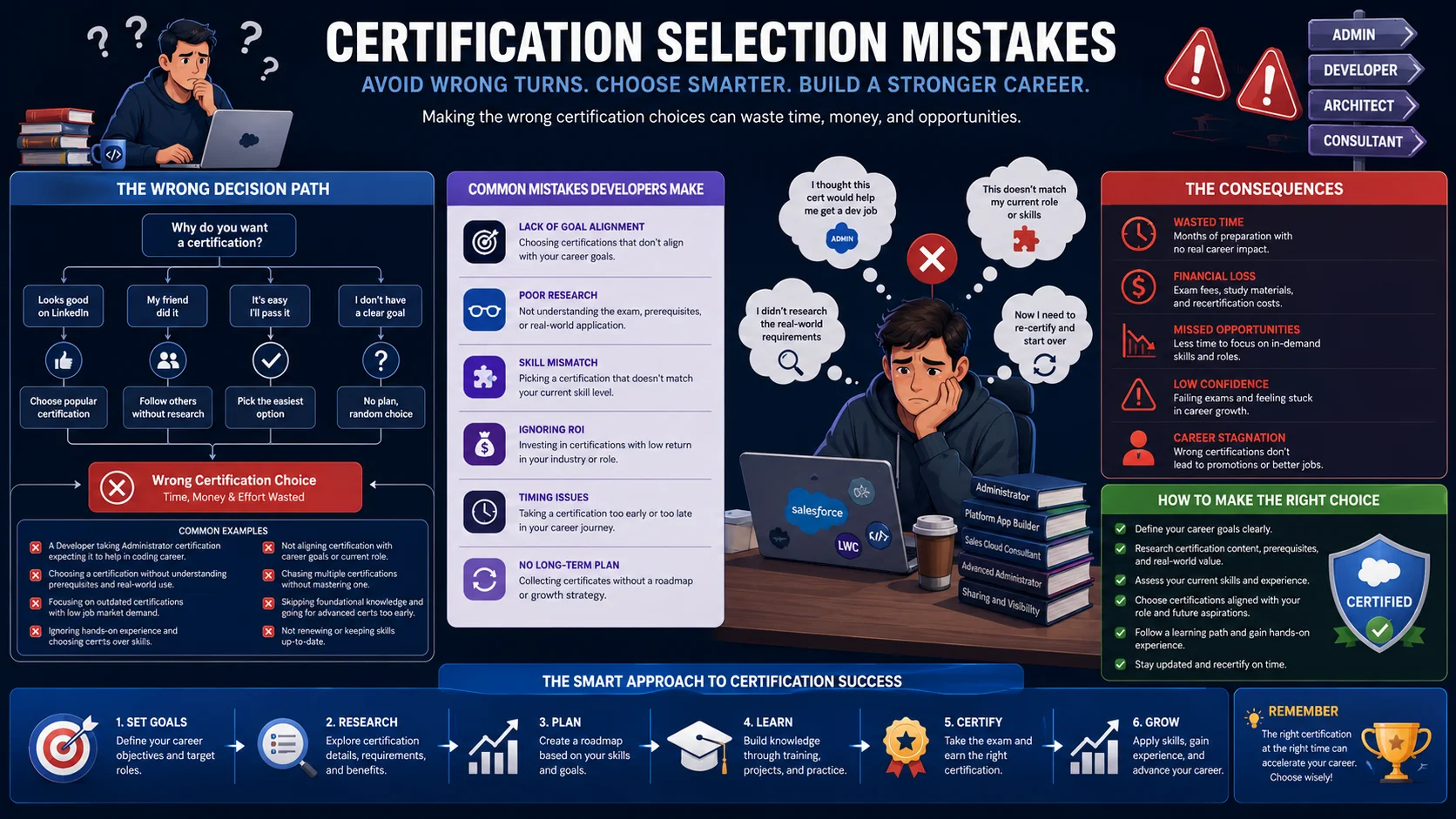
Mistake #1: Choosing Based on Difficulty
The easier certification is usually the one aligned with your current experience.
Mistake #2: Ignoring Long-Term Career Goals
A certification should support the type of work you want to perform in three to five years.
Mistake #3: Assuming B2C Commerce Is Just Another Salesforce Product
B2C Commerce has its own architecture, tools, and development patterns.
Mistake #4: Focusing Only on Exam Objectives
The projects you will build after certification matter far more than the exam itself.
Who Should NOT Pursue These Certifications?
B2B Commerce May Not Be Ideal If:
- You dislike enterprise business processes.
- You prefer front-end development.
- You want to specialize in retail technology.
- You enjoy customer-facing digital experiences more than business systems.
B2C Commerce May Not Be Ideal If:
- You want to become a Salesforce Technical Architect.
- You primarily work with Apex and Lightning components.
- You prefer CRM-focused development.
- You enjoy business process automation more than storefront development.
Understanding who a certification is not for is often more valuable than understanding who it is for.
Should You Earn Both Certifications?
For most professionals, the answer is no – at least not initially.
The two certifications serve different audiences and require different technical skill sets.
A better approach is:
- Master the certification most closely aligned with your current role.
- Gain practical implementation experience.
- Expand into the second certification only if your career path requires broader commerce expertise.
Professionals pursuing enterprise architecture or multi-cloud consulting roles may eventually benefit from holding both credentials.
Final Decision Matrix
| If Your Goal Is… | Best Certification |
| Become a Salesforce Architect | B2B Commerce Developer |
| Stay in the Salesforce Ecosystem | B2B Commerce Developer |
| Build Consumer Shopping Experiences | B2C Commerce Developer |
| Work for Retail Brands | B2C Commerce Developer |
| Use Apex Daily | B2B Commerce Developer |
| Use JavaScript Daily | B2C Commerce Developer |
| Focus on Enterprise Integrations | B2B Commerce Developer |
| Become a Commerce Cloud Specialist | B2C Commerce Developer |
| Work on Procurement Systems | B2B Commerce Developer |
| Build Global Retail Storefronts | B2C Commerce Developer |
Frequently Asked Questions
Is the B2B Commerce Developer Exam harder than the B2C Commerce Developer Exam?
Not necessarily. Difficulty depends largely on your professional background. Salesforce developers typically find B2B Commerce more intuitive, while web developers often adapt faster to B2C Commerce.
Are B2B Commerce Developer Exam Questions enough to pass?
B2B Commerce Developer Practice questions are useful for identifying weak areas and understanding exam structure, but hands-on experience remains one of the most important success factors.
Is a B2C Commerce Developer Practice Test helpful?
Yes. B2C Commerce Developer practice test questions can help candidates become familiar with exam scenarios, identify knowledge gaps, and improve confidence before the actual exam.
Which certification offers better long-term career growth?
Both certifications offer strong opportunities. B2B Commerce often supports broader Salesforce career progression, while B2C Commerce can lead to highly specialized Commerce Cloud expertise.
Can I earn both certifications?
Yes. However, most professionals benefit from first becoming proficient in one platform before expanding into the other.