
If you’re exploring a career as an OmniStudio Consultant, you’re entering one of Salesforce’s most exciting specializations. These consultants build custom digital experiences that connect users, data, and processes in ways that actually make work easier. With businesses pushing hard toward digital transformation, the demand for skilled Salesforce Certified OmniStudio Consultants keeps growing.

What Does an OmniStudio Consultant Actually Do?
Your main job is bridging the gap between business needs and technical solutions. Companies come to you with messy processes and frustrated users. You figure out what’s really needed, then build guided workflows and interfaces using OmniStudio’s low-code platform. Think of yourself as part consultant, part designer, and part problem solver.
The work shows up everywhere. Customer service teams need agents to see complete customer profiles at a glance. Sales teams want streamlined quote processes. HR departments need onboarding portals that don’t confuse new hires. You’re the person making these experiences happen.
The Core OmniStudio Tools You’ll Master
OmniStudio includes four main building blocks: FlexCards display information in clean, responsive card layouts. OmniScripts guide users through multi-step processes with conditional logic. DataRaptors handle data operations without writing code. Integration Procedures connect multiple data sources and APIs into single operations.
Once you understand how these tools work together, you can build sophisticated applications without traditional development timelines. You’ll drag and drop components, configure business rules, and connect data sources. The speed advantage is massive compared to custom coding.
Skills beyond the Platform
Technical knowledge alone won’t cut it. You need to ask smart questions during discovery meetings. What are users actually trying to accomplish? Where do current processes break down? What data lives where? The best OmniStudio consultants excel at translating vague requirements into clear solutions.
You also need design thinking. Just because you can build something doesn’t mean it’s intuitive. Good user experience separates mediocre implementations from great ones. Your solutions should feel obvious to the people using them.
Career Outlook and Certification Path
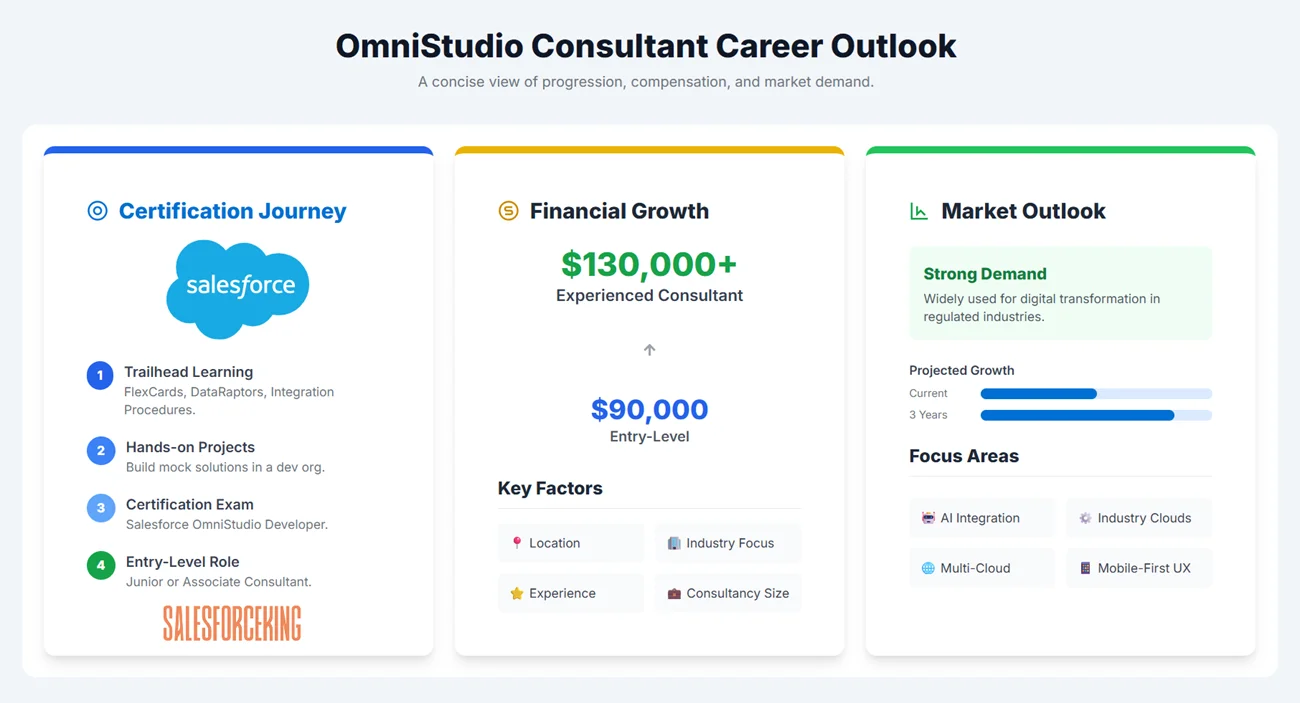
The certification validates your ability to design and implement OmniStudio solutions at a professional level. Salary ranges typically fall between ninety to one hundred thirty thousand dollars, with experienced consultants earning significantly more. Geographic location and industry sector affect compensation.
The Salesforce ecosystem keeps evolving. SalesforceKing explores where things are heading in their article on The Future of Salesforce Certifications: Trends and Predictions. Understanding these trends helps you plan which skills to develop next.
Why OmniStudio Matters Now?
Traditional software development takes months. OmniStudio projects take weeks. Companies need that speed advantage, especially when competing on customer experience. Low-code platforms aren’t replacing developers, but they’re changing who can build certain types of applications.
If you’re comparing certifications, consider your career goals carefully. Different Salesforce specializations suit different working styles and interests. For a realistic assessment of another popular path, check out SalesforceKing piece: Is the Sales Cloud Consultant Certification Worth It? An Honest Review.

Getting Started
Start by learning the platform hands-on through Trailhead. Build sample projects that mirror real business scenarios. Join the OmniStudio community on Salesforce forums. The best way to learn is solving actual problems, even if they’re practice scenarios at first.
The path forward for OmniStudio consultants looks solid. Businesses keep investing in digital experiences, and they need people who can deliver results without massive budgets or timelines. If you enjoy solving problems and seeing your work make a direct impact, this might be your ideal specialization.