
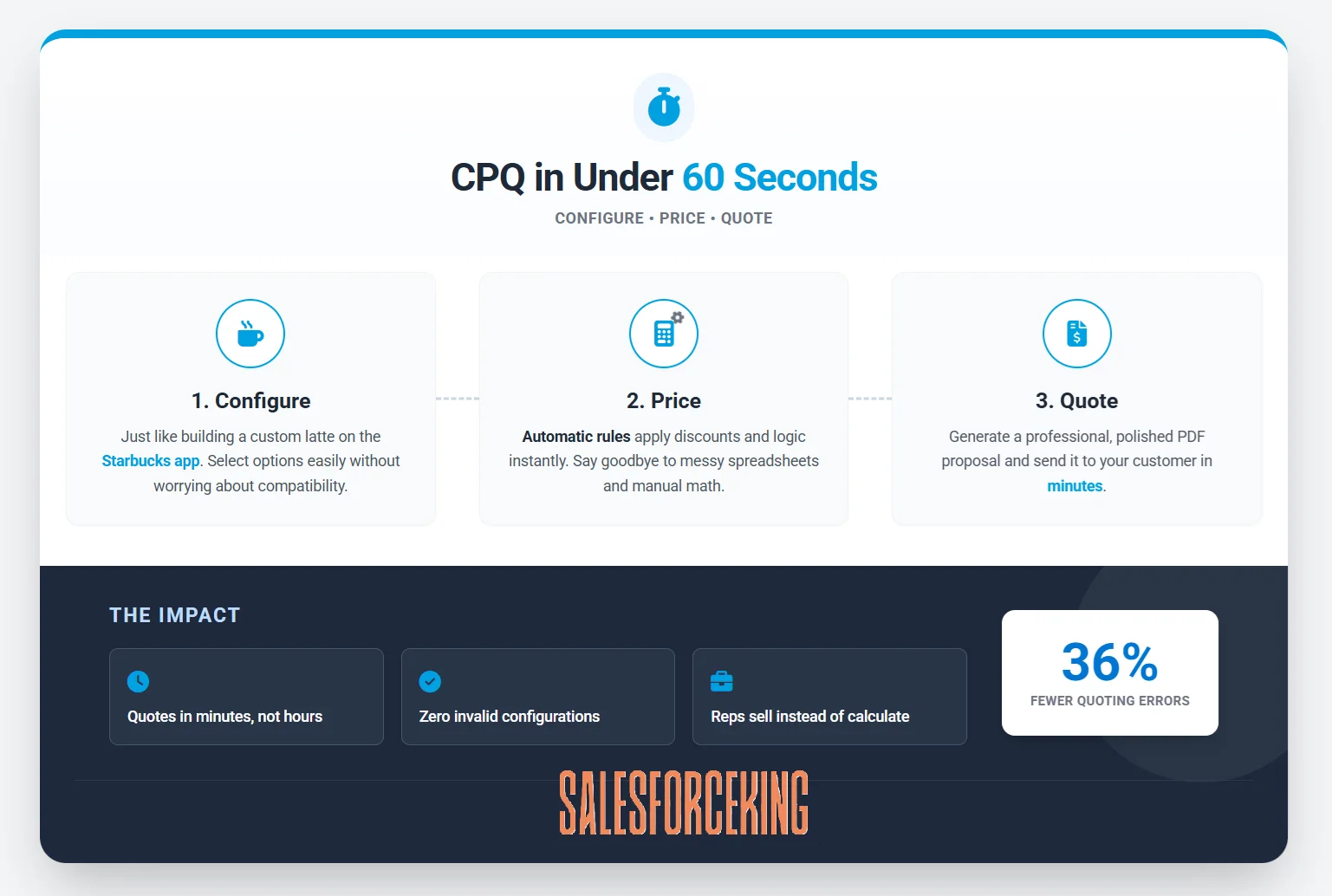
If you’ve ever tried ordering a custom coffee on the Starbucks app, you’ve already used CPQ software. You pick your drink size, add extra shots, choose your milk, and the app instantly tells you the price. That’s Configure, Price, Quote in action. CPQ systems are used by retail consumers every day to customize orders, with the app letting you configure a drink, determining the price using an algorithm, and giving you a full quote.
Now imagine doing that same thing for industrial machinery, enterprise software, or complex service packages. That’s where CPQ gets really powerful for businesses.
Breaking Down What CPQ Actually Means
CPQ stands for Configure, Price, Quote, and it’s a tool that helps sales teams quickly generate accurate quotes for complex products or services by automating the quoting process. Let’s walk through each piece.
Configure is about building the product your customer wants. Users can select products and configure them based on customer requirements, including product bundling, upselling, cross-selling, and dependencies. Think of it like building a car online where certain engine choices only work with specific transmissions.
Price is where the system does the math automatically. CPQ software calculates the price based on multiple variables and is rules-based, customized to address factors that affect profit margins. No more hunting through spreadsheets or calling your manager to check discount approvals.
Quote is the professional document that goes to your customer. Using a predefined framework, CPQ walks reps through the process and helps them create a complete and accurate quote in minutes. What used to take hours now takes minutes.
Why Growing Businesses Actually Need This?
When your company is small, pricing is simple. You’ve got a few products, standard pricing, maybe one discount tier. Easy. But as you grow, everything gets complicated fast.
The biggest obstacle in sales is product complexity, especially when your catalog is full of customizable options. Your sales reps start spending more time building quotes than actually selling. The numbers prove this pain is real. In manufacturing environments, CPQ has been shown to reduce quoting errors by up to 36 percent, directly improving win rates and customer trust.
Here’s the practical impact. Say you have a customer who wants to buy five leather chairs with armrests and no wheels, plus five black swivel chairs with wheels and no armrests. With CPQ, you input the products, update the options, and you instantly have an accurate price. Without it, your rep is manually calculating costs for ten different chair configurations while the customer waits.
The People Making CPQ Work
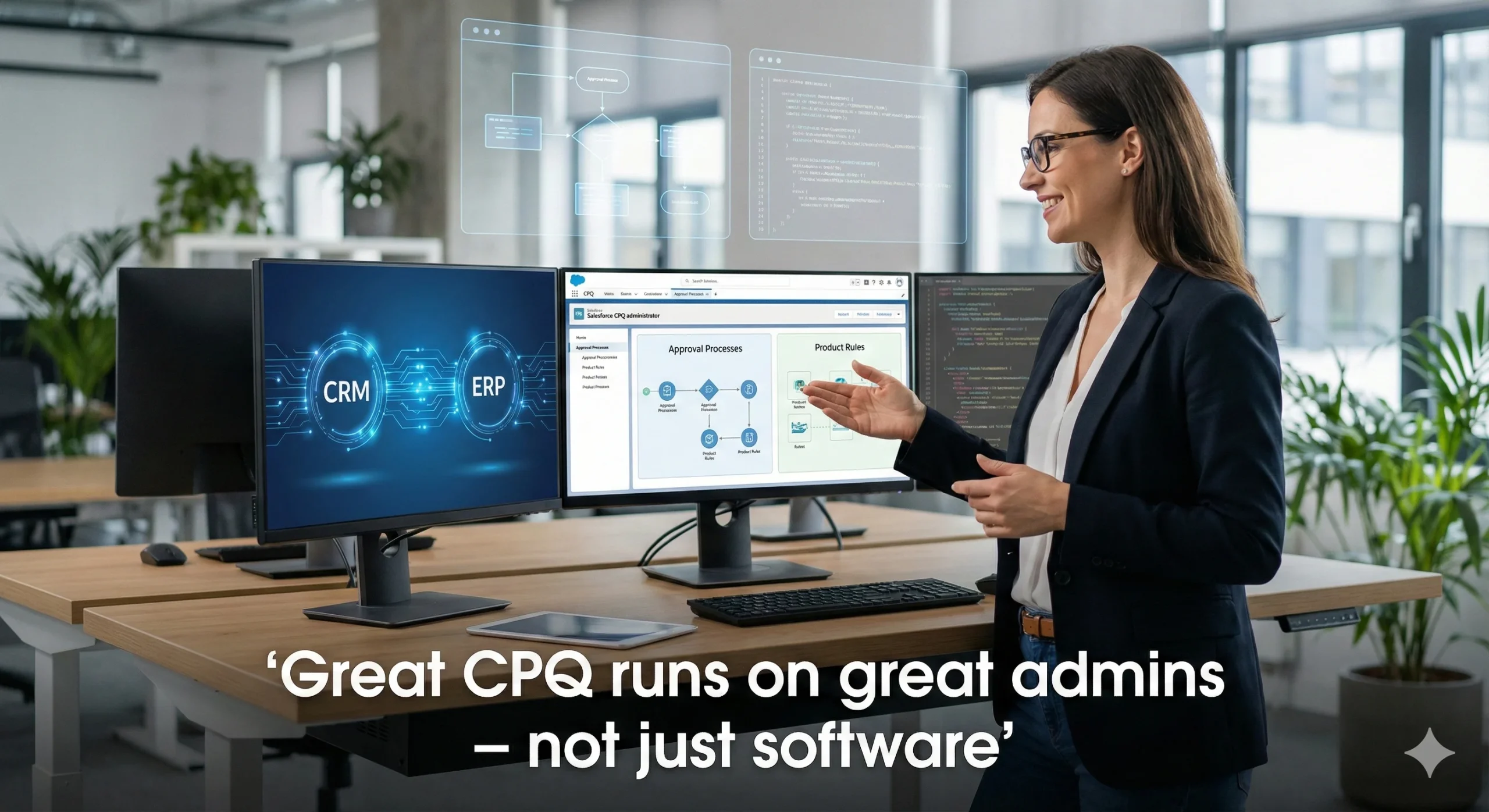
This is where Salesforce CPQ Administrators become essential. These aren’t just button clickers. They’re the people who translate your business rules into the system logic that makes everything work.
Good administrators understand how your products connect, how your discount structure actually functions, and how to build approval workflows that match reality instead of theory. CPQ software integrates seamlessly with existing CRM and ERP systems to provide a holistic view of the sales and production processes, and administrators are the ones making those integrations actually useful.
If you’re bringing CPQ into your company, proper training matters. Resources like How to Use Salesforce Trailhead like a Pro for Certification Prep can help your team build the technical skills needed to run these systems effectively. At SalesforceKing, we’ve watched companies struggle because they bought the software but didn’t invest in the people who run it.
What You Get Out of It?
CPQ lets reps configure, price, and send accurate quotes in minutes instead of hours. Your reps spend less time on admin work and more time talking to customers.
But speed isn’t the only win. CPQ makes sure reps (and customers) can only build things that actually exist and can actually be built. You stop sending out quotes for product combinations that don’t actually exist or can’t be manufactured.
The CPQ space keeps evolving too. Understanding The Future of Salesforce Certifications: Trends and Predictions helps you stay ahead as these tools get smarter and more integrated into how businesses operate.
Time to Make a Choice
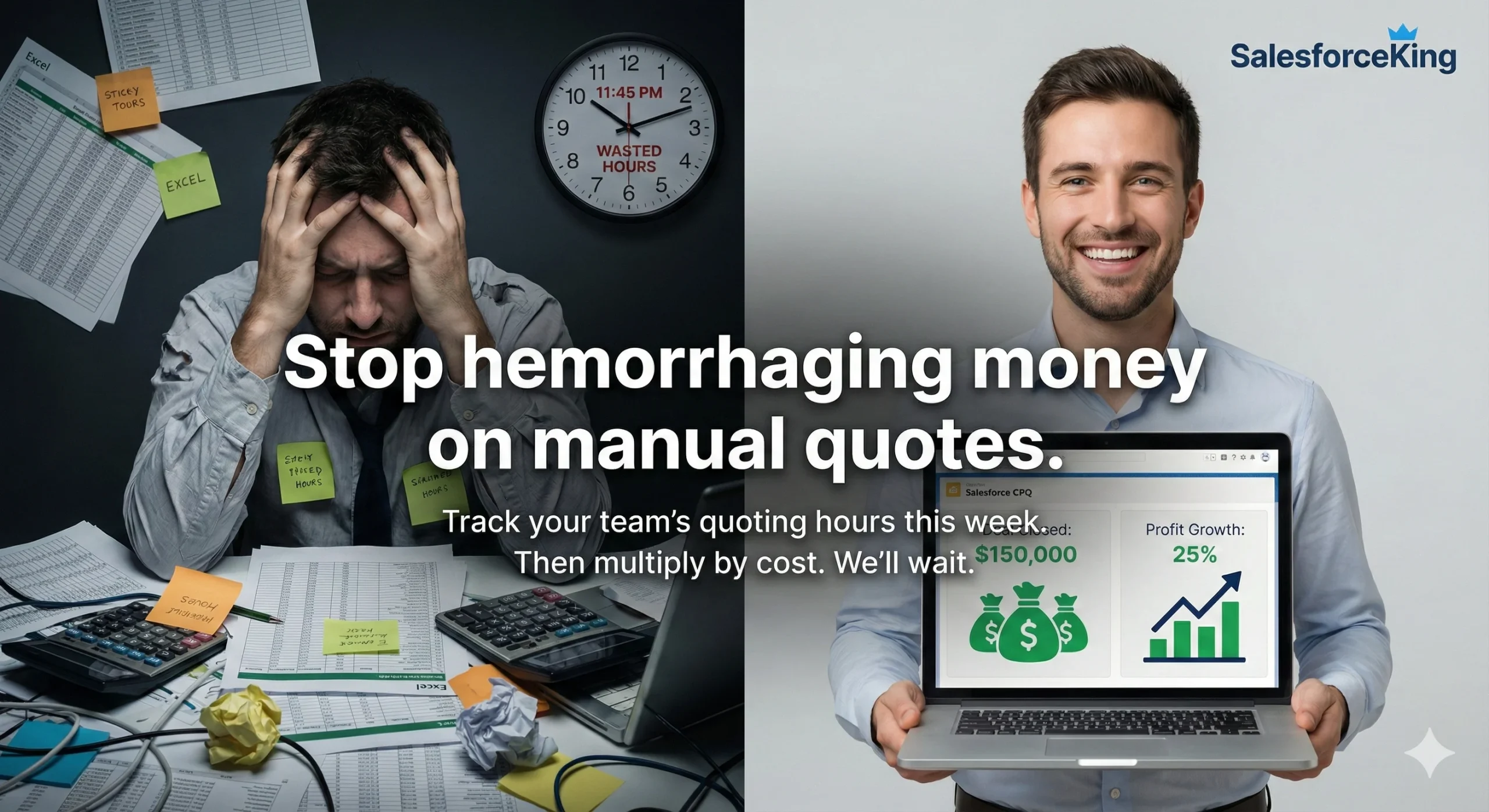
Here’s what it comes down to. If your sales team spends more than a few hours per week manually building quotes, you’re hemorrhaging money. The first vendor to respond to prospects wins 50 percent more deals. Every day you wait is another day your competitors are quoting faster and closing deals while your team is stuck in spreadsheets.
For companies using Salesforce, having skilled Salesforce CPQ Administrators isn’t optional anymore. They’re as critical to your revenue engine as your best sales reps. SalesforceKing has a simple exercise for you: track how many hours your team spends on quotes this week. Multiply that by your average hourly cost. That number should bother you enough to do something about it. Stop letting manual processes kill your momentum. Your team deserves better tools, and your customers deserve faster answers.